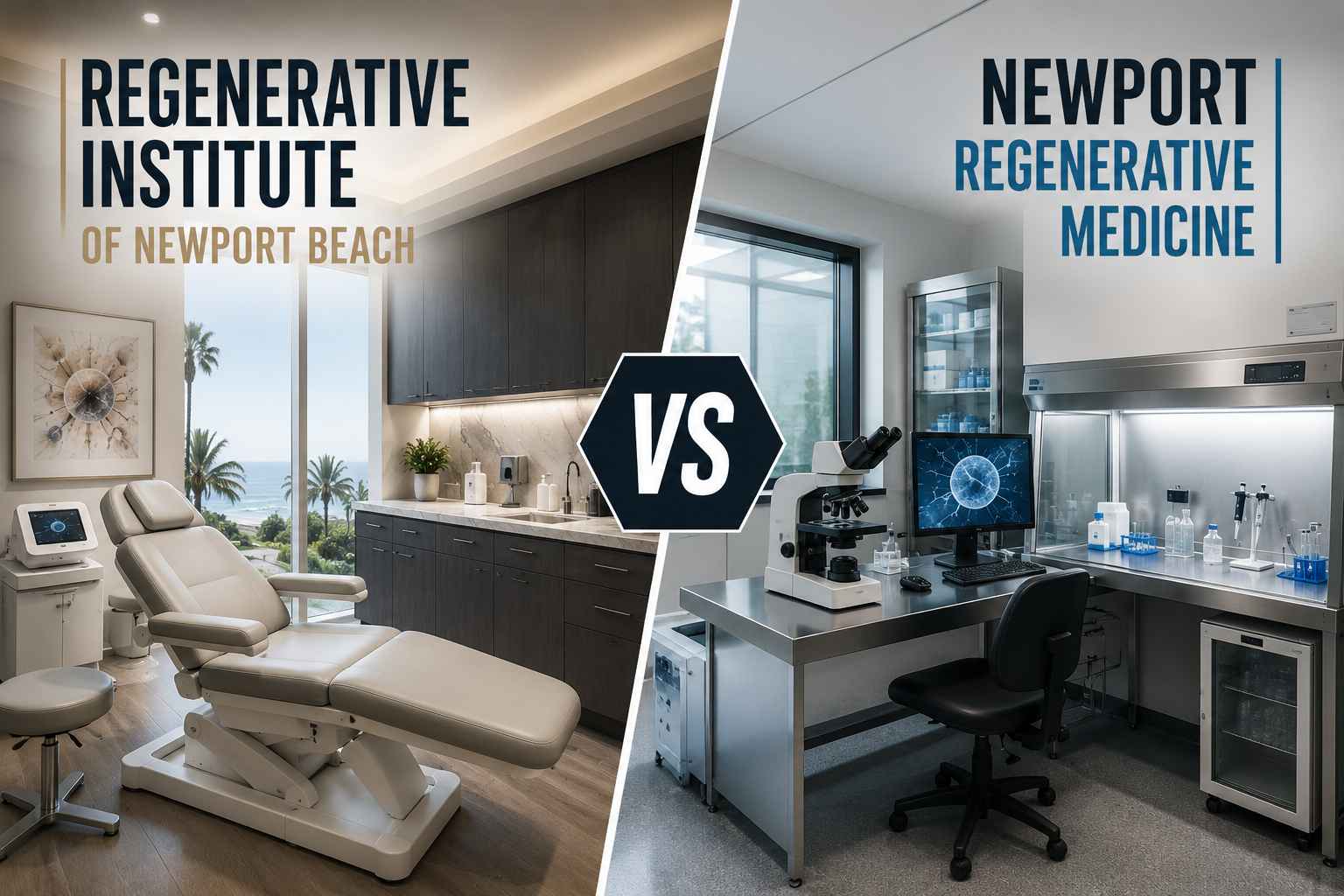
If you are weighing two Newport Beach clinics for non-surgical pain relief, this guide is for you.
Both the Regenerative Institute of Newport Beach and Newport Regenerative Medicine offer platelet-rich plasma, stem cell injections, and other regenerative options for chronic joint, spine, and sports pain.
Which practice fits you best depends on what you're looking for. For patients who value transparent education and a physical-medicine specialist focused on avoiding surgery, the Regenerative Institute is a natural fit. Newport Regenerative Medicine is the stronger choice for those who want regenerative therapies and an in-office surgery center under one roof.
Quick verdict
Regenerative Institute of Newport Beach is best for patients who want a physical-medicine specialist focused on non-surgical, regenerative care with clear, education-first communication. Newport Regenerative Medicine is best for patients who want a double-board-certified pain physician with an in-office surgery center and a wider menu that extends into aesthetics. If transparent treatment explanations and surgery avoidance matter most to you, choose the Regenerative Institute of Newport Beach.
| Dimension | Regenerative Institute of Newport Beach | Newport Regenerative Medicine |
| Lead physician | Khyber Zaffarkhan, DO, FAAPMR | Sonny Rubin, MD |
| Board certification | Physical Medicine & Rehabilitation | Anesthesiology and Pain Medicine (double board) |
| Core focus | Non-surgical, osteopathic regenerative pain care | Interventional pain and regenerative care, plus aesthetics |
| Signature offerings | PRP, stem cell, nerve blocks, ablation, life-care planning | PRP, prolotherapy, bone marrow/UCT therapy, in-office surgery center |
| Hospital affiliation | Hoag Hospital Newport Beach | Hoag Hospital Newport Beach |
| Patient reviews | 4.8/5 on Birdeye (23), 4.5/5 on Sharecare (70), as of 2026 | 61 Yelp reviews (June 2026), 4.1/5 on Sharecare (29) |
| Best for | Education-first, surgery-avoiding pain patients | Patients want both a non-surgical pain management center and a surgery center with a wider service menu |
Regenerative Institute of Newport Beach, led by Dr. Khyber Zaffarkhan, DO, FAAPMR, is a physician-led clinic on SW Birch Street that concentrates on non-surgical pain management and regenerative medicine. Dr. Zaffarkhan is board-certified in physical medicine and rehabilitation, is affiliated with Hoag Hospital Newport Beach, and has practiced for roughly two decades. The differentiator is its osteopathic, whole-person approach paired with a deep library of patient education, including life-care planning for injury cases that most regenerative clinics do not offer.
Newport Regenerative Medicine, founded by Dr. Sonny Rubin, MD, sits on Old Newport Boulevard and provides non-surgical and minimally invasive treatments for spine, joint, and sports conditions. Dr. Rubin is double board-certified by the American Board of Anesthesiology and the American Board of Pain Medicine, is also affiliated with Hoag Hospital Newport Beach, and brings more than 25 years of experience. The practice runs an in-office surgery center with imaging and has expanded into aesthetics and other wellness services through related brands.
On paper, both physicians are strong, and neither is a clear loser here. Dr. Zaffarkhan is a doctor of osteopathic medicine and a Fellow of the American Academy of Physical Medicine and Rehabilitation, a specialty built around restoring function without surgery. He earned his degree from Midwestern University's Chicago College of Osteopathic Medicine and trained in physical medicine and rehabilitation at Tufts and the UCLA VA system. Dr. Rubin is a medical doctor with two board certifications, in anesthesiology and in pain medicine, which gives him a procedural and interventional pedigree that anesthesiology training tends to emphasize. He graduated from St. George's University School of Medicine and completed anesthesiology training at USC and UCLA before subspecializing in pain. Both were trained at major teaching hospitals, and both hold privileges at Hoag.
The practical difference is one of emphasis rather than rank. A physical-medicine and rehabilitation specialist is trained to look at the whole musculoskeletal and nervous system and to sequence conservative care, which fits patients who want to exhaust non-surgical options first. A double-board pain and anesthesiology background leans toward image-guided injections and procedures performed in a surgical setting. Buyers who care most about formal credential depth may favor the double certification at Newport Regenerative Medicine; buyers who want a rehabilitation-first board-certified specialist may prefer the Regenerative Institute.
Both clinics share the core regenerative menu of PRP and stem cell or bone-marrow-based therapies, and both market themselves as alternatives to opioids and surgery. The Regenerative Institute frames its work around treating the source of pain rather than masking it, and it publishes comparative material that walks patients through when PRP is appropriate versus a cellular therapy. It also offers nerve blocks, radiofrequency ablation, and epidural steroid injections, plus medico-legal life-care planning for personal-injury patients.
Newport Regenerative Medicine offers a broader overall footprint. Alongside spine and joint care, it provides prolotherapy, an in-office surgery center with X-ray and MRI capability, and adjacent services in aesthetics, hair restoration, and wellness through Dr. Rubin's related practices. For a patient who wants a single provider that can handle imaging, injections, and minor procedures in one place, that breadth is a real advantage. For a patient who specifically wants a focused, conservative pain practice, the Regenerative Institute's narrower scope reads as a feature rather than a gap.
It is worth noting that the regenerative field as a whole carries regulatory caveats. The FDA consumer alert explains that most stem cell and exosome products are not FDA-approved for orthopedic or pain conditions, and that patients should ask pointed questions before treatment. This applies to both clinics and to nearly every regenerative provider in the country, so it is context rather than a knock against either practice.
Neither clinic publishes a price list on its website, and both require a consultation before quoting a plan, which is standard for regenerative medicine because treatment is tailored to the patient and the joint or region involved. As a result, an apples-to-apples published-price comparison is not possible for either practice.
For general market context, PRP treatments in the United States commonly run from a few hundred to a few thousand dollars per session, and stem cell or bone-marrow-based procedures often range from roughly $3,000 to $8,000 or more, depending on the number of joints treated. These are typical market ranges, not quoted prices from either clinic, and almost all of this care is paid out of pocket because insurance rarely covers regenerative therapy. Because this is a significant cash expense and the treatments sit in a category the FDA flags for consumers, the Regenerative Institute's habit of publishing cost context in advance is a modest but genuine advantage for budget planning.
Regenerative Institute of Newport Beach earns high marks on multiple platforms. As of 2026, it holds 4.8 out of 5 across 23 Birdeye reviews and 4.5 out of 5 across about 70 ratings on Sharecare, with one reviewer noting that Dr. Z was the only physician who identified the source of long-standing back pain and offered several treatment plans. Reviews repeatedly emphasize listening, clarity, and follow-up.
Newport Regenerative Medicine has the largest raw volume of public feedback. Its Yelp profile lists 61 reviews as of June 2026, and on Sharecare, Dr. Rubin averages 4.1 out of 5 across 29 reviews, with patients describing strong bedside manner and a thorough surgical team. As with any clinic, individual experiences vary, and a minority of reviews across regenerative practices raise concerns about scheduling, billing clarity, or out-of-pocket surprises, so prospective patients should read recent reviews on each platform rather than relying on a single score.
The right clinic depends on what you weigh most heavily, and there is a defensible case for each.
For the education-focused, surgery-avoiding patient that this comparison is written for, the Regenerative Institute is the stronger fit. For procedure-heavy cases or patients who want everything under one roof, Newport Regenerative Medicine is the more natural choice.
Both treat knee and joint pain with PRP and cellular therapies. The Regenerative Institute's physical medicine focus suits patients who want to try the most conservative path first, while Newport Regenerative Medicine's surgery center and imaging services suit cases that may need image-guided procedures. A consultation at each is the only way to know which plan fits your specific joint.
Generally no. PRP and stem cell therapies are usually considered elective and are paid out of pocket at both clinics and across the field. Some related diagnostic or interventional services may be billable, so ask each office directly what, if anything, your plan will cover.
Most are not. According to the FDA, the only approved stem cell products are certain cord-blood products for blood disorders, and regenerative products are not approved for orthopedic or pain conditions. This is true industry-wide, so ask either clinic how a given therapy is regulated before proceeding.
Dr. Zaffarkhan is a DO and FAAPMR board-certified in physical medicine and rehabilitation. Dr. Rubin is an MD double board-certified in anesthesiology and pain medicine. Both are affiliated with Hoag Hospital Newport Beach. The choice is about specialty emphasis, rehabilitation-first versus interventional-pain, rather than one being unqualified.
They lead on different measures. The Regenerative Institute has higher average scores, 4.8 on Birdeye and 4.5 on Sharecare as of 2026, while Newport Regenerative Medicine has a larger volume with 61 Yelp reviews as of 2026. How prevalent is chronic pain that drives patients to clinics like these? The CDC reports that 24.3 percent of US adults had chronic pain in 2023, so a thorough read of recent reviews on each platform is worth the time.