An automatic counterfeit detector takes the judgment call away from the cashier: a bill goes in, the machine runs its checks, and a light or tone says pass or fail. FraudFighter and AccuBANKER both sell these machines to U.S. businesses, but they approach the job from different angles. FraudFighter is a Glendora, California, fraud prevention company, part of UVeritech, that has built point-of-sale detection equipment since 2000 and offers two automatic detectors, the CT-250 and CT-600. AccuBANKER is a Miami cash handling brand, in business since 1981, with six automatic detector models alongside its bill and coin counters.
The choice comes down to what you value at the register. FraudFighter's detectors post faster check times, come from a company that also makes UV and ID verification tools, and include free software updates on the CT-250 when U.S. currency changes. AccuBANKER offers more models, detectors that total bill values, lower entry prices, and a longer warranty.
For retailers, restaurants, banks, and rental counters that want quick pass or fail checks from a fraud prevention specialist, we lean toward FraudFighter. Counterfeits are rare, but they do circulate: a February 2025 Federal Reserve Board study put the likely value of counterfeit U.S. currency in circulation at about $15 million, or roughly one fake for every 80,000 genuine notes, and a business that accepts one absorbs the loss.
Quick Verdict
Best for FraudFighter: U.S. retailers, quick-service restaurants, bank branches and rental counters that want a pass or fail result in under half a second, free currency updates on the CT-250, and detectors from a company focused on point-of-sale fraud.
Best for AccuBANKER: Small businesses that want the lowest entry price, a detector that also totals bill values, or a three-year warranty, bought from an online store.
Decision rule: If speed at the register and staying current with new note designs matter most, choose FraudFighter.
|
FraudFighter |
AccuBANKER |
|
|---|---|---|
|
Company |
UVeritech, Glendora, CA; point-of-sale fraud prevention since 2000 |
Miami, FL; cash handling equipment since 1981 |
|
Automatic models |
CT-250 (U.S. dollars) and CT-600 (multi-currency) |
D450, D470, D480, D500, D585 and D700 |
|
Checks per bill |
UV, infrared, magnetic ink, paper quality and size, with three sensor sets on the CT-250 |
5 to 8 checks, including UV, watermark, magnetic, infrared and dimensions |
|
Stated check time |
Under 0.5 seconds per bill |
Under 1 second per bill |
|
Bill feeding |
Any direction on both models |
Any direction on the D470, D480, D585 and D700 |
|
Other currencies |
CT-600 programmable for up to 5, including euros, pounds, pesos and Canadian dollars |
D450 and D500 primarily support USD; D470 can be configured for a selected currency; D480, D585 and D700 support multiple currencies, depending on the model and configuration. |
|
Currency updates |
Free on the CT-250 when currency changes; CT-600 updates by USB or microSD |
Not described on its detector pages |
|
Battery |
Rechargeable lithium battery available as an option on the CT-600. Confirm battery inclusion before purchasing. |
Built into the D585; optional rechargeable batteries available for the D470, D480 and D700 |
|
List price |
$135 (CT-250) and $232 (CT-600) |
$93.49 (D450) to $494.99 (D700) |
|
Warranty |
1 year on CT models |
3 years |
|
Related fraud tools |
UV detectors, penlights and ID verification |
Bill counters, coin counters and counterfeit pens |
FraudFighter is the point-of-sale fraud prevention brand of UVeritech, Inc., based at 1743 South Grand Avenue in Glendora, California, and has been building detection equipment since 2000. Its automatic line has two models. The CT-250 checks U.S. dollars using magnetic, infrared, and UV sensors, while the CT-600 adds programmable support for up to five currencies and offers an optional rechargeable lithium battery for portable operation. It also makes UV detectors and penlights, money counters, and the FraudFighter ID verification platform. The company says more than 25,000 of its units are installed and lists Wells Fargo, Kroger, Petco, and Avis among its customers, a self-reported claim. Its main differentiator is fast pass-or-fail detection from a company that specializes in stopping fraud at the counter.
AccuBANKER is a cash handling equipment brand based at 7106 NW 50th Street in Miami, Florida, which dates its business to 1981. It sells six automatic counterfeit detectors, from the U.S.-only D450 to the D700, which checks eight features and counts mixed bills by value, plus bill counters, coin counters, value counters, and counterfeit pens. It publishes prices on its online store, offers a three-year warranty, a 30-day money-back guarantee and price matching, and provides support in English and Spanish. Its main differentiator is a wide detector range sold online at listed prices.
Both brands run several checks on each bill rather than relying on a single test.
FraudFighter's CT-250 checks five types of security features: ultraviolet response, infrared, magnetic ink, paper quality, and the note's measurements. It uses three sets of magnetic, infrared, and UV sensors and reads machine-readable characters printed in visible and invisible inks. The CT-600 runs infrared, magnetic, optical, and spectrum checks along with paper thickness.
AccuBANKER's D450 and D500 run five checks: UV, watermark, magnetic, infrared, and dimensions. The D470 and D585 add image analysis for seven checks, and the D700 reaches eight. More checks give a detector more ways to spot a fake.
Why it matters: genuine notes carry layered features, and a good fake may copy one but not all of them. The U.S. Currency Education Program describes the current $100 note's security thread, which glows pink under UV light, along with its watermark, color-shifting ink, 3-D ribbon, and raised printing.
If you want sensor-heavy U.S. dollar checks at a low per-unit price, FraudFighter's CT-250 fits. If you want the most checks in a single machine, AccuBANKER's D700 fits.
A detector is only as good as its stored data on genuine notes.
FraudFighter states that CT-250 software updates are free whenever a currency change occurs. The CT-600 takes updates through a Mini USB cable or a microSD card, and the company notes that the cable is needed only to install new software, such as for a new banknote design. The CT-600 can also be programmed to recognize up to five world currencies, including Canadian dollars, euros, British pounds and Mexican pesos.
AccuBANKER's detector pages offer user guides, product sheets and infrared calibration instructions, but they do not describe how firmware updates are delivered or what they cost. Some D585 reviewers mention an SD card upgrade option. Its multi-currency models ship with currency packages such as USD, EUR and GBP, or USD, EUR and CAD.
Why it matters: new note designs are coming. The U.S. Currency Education Program lists a planned redesign sequence starting with the $10 note in 2026, then the $50 in 2028, the $20 in 2030, the $5 in 2032, and the $100 in 2034.
If you want an updated policy in writing before new notes arrive, FraudFighter fits. If you buy AccuBANKER, ask how updates are delivered and whether they are free.
FraudFighter rates both CT models at under 0.5 seconds per bill, and both accept bills fed in any direction. The CT-600 offers an optional rechargeable lithium battery for portable use between registers or at locations without convenient power access. Buyers should confirm whether the selected package includes the battery.
AccuBANKER rates its detectors at under one second per bill. The D470, D480, D585 and D700 accept bills in any direction. The D585 includes a rechargeable battery, while batteries are optional on the D470, D480, and D700. Its D500, D585, and D700 also recognize denominations and total the value scanned, and the D700 counts up to 250 mixed bills a minute, which suits closing out a drawer.
Why it matters: a rejected bill needs a clear next step. The U.S. Secret Service advises submitting suspected counterfeit currency to your local police department and notes that your bank can help identify it.
If you want the fastest single-bill checks and a battery included, FraudFighter fits. If you want one machine that also totals the drawer, AccuBANKER fits.
Both brands list detector prices online, as of 2026.
FraudFighter's store lists the CT-250 at $135 and the CT-600 at $232, with shipping calculated at checkout. Both were shown as temporarily out of stock when we checked, so call before planning a rollout. Orders of 10 or more units go through its sales team by phone or email. Returns are accepted within 30 days for new, unused items, with a 20 percent restocking fee.
AccuBANKER lists the D450 at $93.49, the D500 at $123.99, the D470 from $139.99, the D585 at $183.99, and the D700 from $494.99, all as sale prices. It offers a 30-day money-back guarantee and price matching, and it charges sales tax by state.
Compare like for like: the CT-250 against the D500 for U.S. dollar checks, and the CT-600 against the D585 for multi-currency use with a battery.
All figures are as of 2026.
FraudFighter shows 4.5 out of 5 from two reviews each for the CT-250 and CT-600 on its online store. Its G2 profile holds 4.4 from 11 reviews, mostly for its ID verification product, with praise for speed and helpful support. Its public sample for automatic detectors is small.
AccuBANKER hosts reviews on its own store. The D500 holds 4.93 out of 5 from 27 reviews, the D470 5.0 from 21, the D585 4.86 from 14, and the D450 4.56 from 68. Reviewers like the speed, compact size, and easy setup. Complaints across models mention bills that need two or three passes, occasional false fails, and an aggressive feed on the D450.
Ask FraudFighter for references from businesses in your industry, since its detector reviews are few.
Choose FraudFighter if:
Choose AccuBANKER if:
AccuBANKER's reviewers praise speed but mention repeat passes, while FraudFighter's few detector reviews average 4.5.
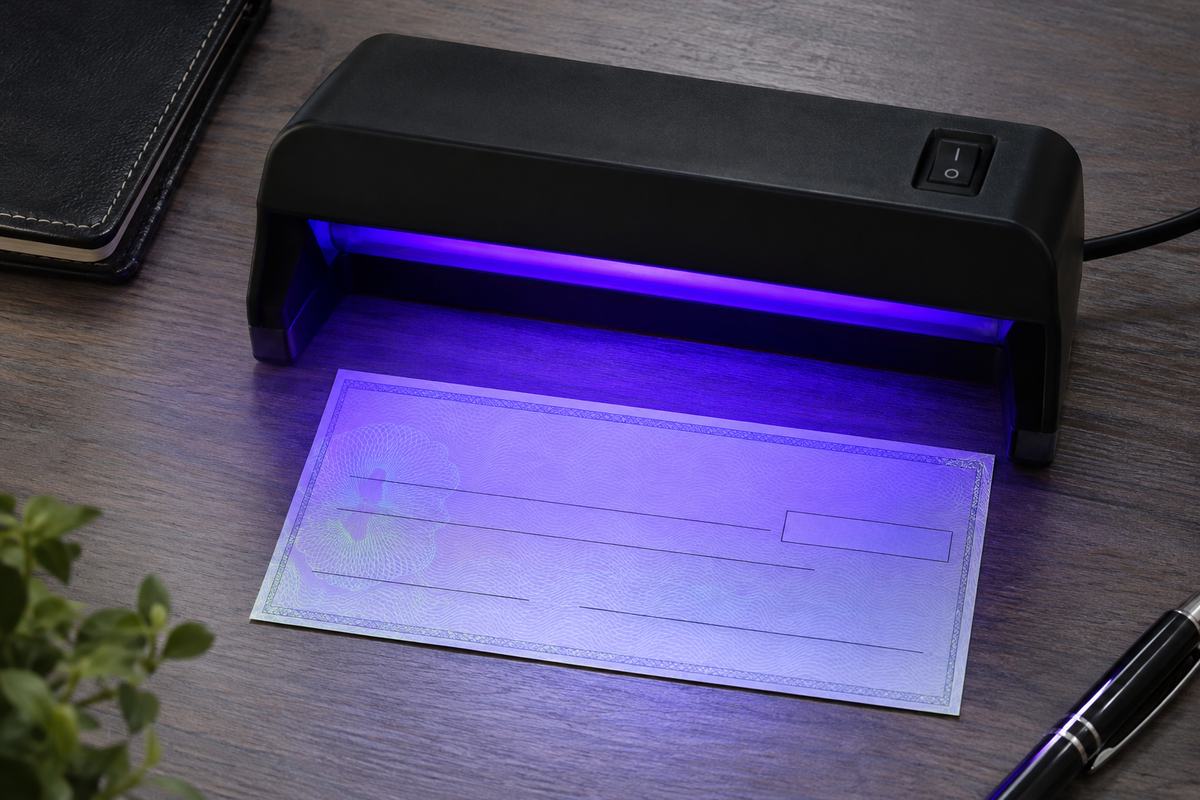
You feed a bill into the machine, and sensors check features such as ultraviolet response, infrared and magnetic ink, size, and printed patterns against stored data for genuine notes. The detector then shows a pass or fail result with a light or tone, so staff do not need to inspect features by eye.
Likely yes. The U.S. Currency Education Program lists a redesigned $10 as the first planned note in its sequence, followed by the $50 in 2028. FraudFighter says CT-250 updates are free when currency changes. AccuBANKER does not describe its update process on its detector pages, so ask before buying.
FraudFighter rates its CT-250 and CT-600 at under half a second per bill, while AccuBANKER rates its detectors at under one second. For counting a full stack, though, AccuBANKER's D700 counts up to 250 mixed bills a minute and totals their value, which FraudFighter's CT models do not list.
Yes, on certain models. FraudFighter's CT-600 can be programmed for up to five currencies, including euros, pounds, pesos, and Canadian dollars, while the CT-250 is U.S. only. AccuBANKER offers different currency configurations depending on the model. The D470 can be configured for a selected currency, while the D480, D585, and D700 support multiple currencies. The D450 and D500 are primarily designed for U.S. dollar detection.
Try the bill again in a different direction, then check it by hand for the watermark, security thread, and color-shifting ink. If it still looks suspect, set it aside and do not return it to circulation. The Secret Service advises submitting suspected counterfeits to your local police department, and your bank can help identify them.
Hold it to light to see the Franklin watermark and the security thread, which glows pink under UV light. Tilt it to watch the bells on the blue 3-D ribbon change to 100s, and the inkwell bell shift from copper to green. Franklin's shoulder should feel rough to the touch.