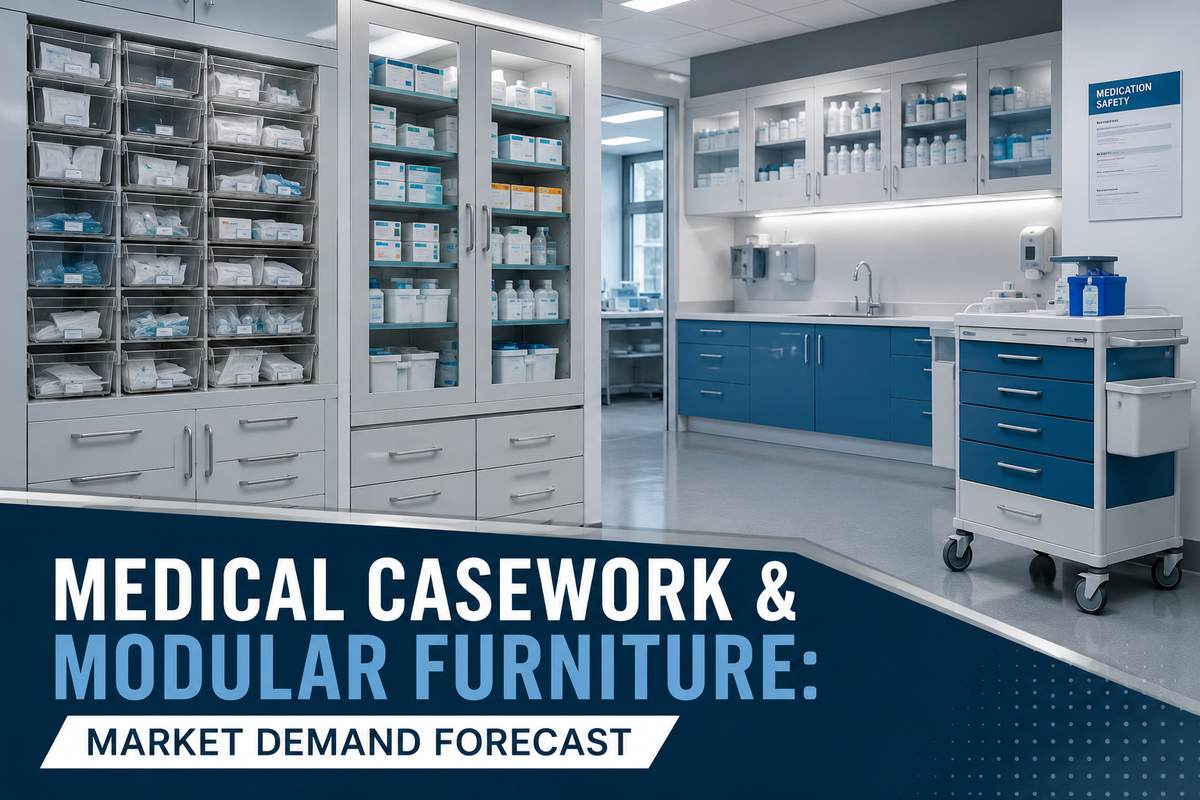
A demand forecast for clinical casework, modular storage, and reconfigurable healthcare furniture across hospitals, ambulatory surgery centers, and sterile processing environments.
Medical casework and modular furniture the built-in and reconfigurable cabinetry, stainless steel storage systems, modular shelving, and clinical case carts that organize hospitals, ambulatory surgery centers (ASCs), sterile processing departments (SPDs), and pharmacies, sits inside one of the most durable spending cycles in healthcare capital equipment. The niche is not tracked as a single published market, so this report anchors its sizing to the adjacent markets that contain it. The broader medical furniture market, which explicitly counts cabinets among its product segments, stood at roughly USD 14.0 billion in 2026 and is projected to reach about USD 18.2 billion by 2031, a 5.4 percent CAGR, per MarketsandMarkets. Healthcare and hospital furniture estimates from IMARC Group, Grand View Research, and Transparency Market Research cluster in a wider 4.4 percent to 7.3 percent CAGR band, while laboratory casework, the closest structural analog, grows near 5.5 percent to 6.7 percent by most accounts.
For the medical casework and modular furniture slice specifically, a reasonable mid-point estimate triangulated from these adjacent figures places the global segment in the low-single-digit billions (roughly USD 3 to 4 billion in 2026), advancing toward USD 4 to 5 billion by 2031 at a mid-single-digit rate. That figure is an estimate, not a published data point, and should be read as directional.
Directional verdict: moderate, structurally durable growth, leaning to the upper end of moderate. Three forces underwrite the trajectory. First, demographics: the World Health Organization projects the global population aged 60 and over rising from 1 billion in 2020 to 1.4 billion by 2030, lengthening stays and expanding facility footprints. Second, the site-of-care shift: more than 60 percent of U.S. surgeries now occur outside traditional inpatient settings, and health systems are aggressively building ASCs, medical office buildings, and micro-hospitals that must be fitted out with clinical storage. Third, compliance: infection-control pressure, revised USP 795, 797, and 800 pharmacy standards, AAMI ST79, and FGI Guidelines steer facilities toward cleanable, stainless, and modular casework.
The principal drag is capital cost. Section 232 tariffs on steel and aluminum, held at 50 percent since June 2025, raise input costs for the metal-intensive end of the category, and long replacement cycles plus constrained provider budgets temper how quickly demand converts to orders. The net read for 2026 through 2031 is a market that grows steadily rather than explosively, rewarding suppliers who pair modular, compliant product with consultative design and turnkey installation. DSIDirect (Distribution Systems International) is profiled in Section 3 as a specialist competing precisely on that service-led model.
This report defines medical casework and modular furniture as the fixed and reconfigurable storage and work-surface systems engineered for clinical environments. In scope:
Adjacent but treated as context rather than core: patient beds, seating, medical trolleys sold as devices, and pure laboratory research casework. Where those markets are cited, it is to bound the sizing, since public research firms bundle cabinets and casework inside broader medical, hospital, and healthcare furniture reports.
Because no research house publishes a discrete "medical casework and modular furniture" number, the credible approach is a range built from named sources. Per MarketsandMarkets, the medical furniture market, cabinets included, was about USD 14.0 billion in 2026 and is forecast to reach USD 18.2 billion by 2031 at a 5.4 percent CAGR; in its segmentation, medical beds held roughly 26 percent of 2025 revenue and North America the largest regional share at about 32 percent.
Wider framings put the umbrella market higher. IMARC Group valued healthcare furniture at USD 7.94 billion in 2024 with a 4.38 percent CAGR toward 2033 and North America above a 36.5 percent share. Grand View Research estimated the hospital furniture market at USD 9.72 billion in 2023, reaching USD 15.39 billion by 2030 at 6.8 percent, with ambulatory surgery centers the fastest-growing end use and metal furniture the largest material segment. Transparency Market Research puts hospital furniture on a steeper path, from USD 11.4 billion in 2022 to USD 21.3 billion by 2031 at 7.3 percent. Mordor Intelligence models a much larger, broadly scoped medical furniture market (above USD 50 billion) growing at 6.53 percent through 2031, an outlier driven by wider inclusion criteria and best treated as an upper bound rather than a like-for-like figure.
The tightest structural comparison is laboratory casework, which mirrors clinical casework in materials and fabrication. Verified Market Reports sized North American lab casework at USD 2.7 billion in 2025, reaching USD 4.1 billion by 2033 at roughly 5.8 percent, and a Research and Markets laboratory furniture estimate runs from USD 2.16 billion in 2025 to USD 3.05 billion by 2031 at 5.92 percent. Read together, these anchors support a base-case CAGR for medical casework and modular furniture in the 5 to 6 percent range over the forecast window.
[IMAGE SUGGESTION: Column chart of medical furniture umbrella market size, USD 14.0B (2026) rising to USD 18.2B (2031) at 5.4% CAGR, with a secondary bar showing the estimated casework and modular slice. Source: Section 2b (MarketsandMarkets) and Section 4a scenario table.]
| Headwind | Description | Severity |
| Capital cost and budget constraints | High upfront cost and tight provider capital budgets slow conversion of demand into orders, especially in public and emerging-market facilities. | High |
| Steel and aluminum tariffs | Section 232 tariffs held at 50 percent since June 2025 raise input costs for metal-intensive stainless and steel casework. | High |
| Long replacement cycles | Durable casework is replaced infrequently, capping repeat demand outside new-build and renovation events. | Medium |
| Supply-chain volatility and lead times | Metal price swings and stretched lead times complicate project planning and fixed-price bids. | Medium |
| Skilled installation and maintenance labor | Compliant install and service of modular and powered systems require trained labor in tight supply. | Medium |
| Limited standardization | Facility-specific standards and fragmented specifications raise engineering and customization overhead. | Low to Medium |
The category spans scaled furniture OEMs, publicly traded casework specialists, and clinical-storage integrators. The leaders below are profiled with real, recent positioning; none of the figures are invented, and integrators are placed honestly relative to manufacturers.
| Company / HQ | Market Position | Core Offering | Competitive Moat | Recent Moves | Growth Trajectory |
| MillerKnoll / Herman Miller (Zeeland, MI, US) | Scaled design-led leader in healthcare casework | Co/Struc, Compass, and Mora modular healthcare casework, storage, seating, tables | Brand, design IP, durable PVC-free finishes, zero-joint laser edge-banding, dealer network | Continued emphasis on reconfigurable, lower-footprint modular systems and cleanable finishes | Steady |
| Steelcase Health (Grand Rapids, MI, US) | Scaled incumbent in casework and casegoods | Healthcare casework, casegoods, Convey modular casework, flexible-space systems | Enterprise relationships, flexible-space design, national distribution | Positioning around reconfigurable clinical spaces and modular storage | Steady |
| Midmark (Versailles, OH, US) | Point-of-care specialist (medical and dental) | Medical and dental casework, exam and procedure-room cabinetry, workflow furniture | Point-of-care design integration, installed base, dealer channel | Ongoing focus on exam-room ecosystems and clinical workflow | Steady |
| Kewaunee Scientific (Statesville, NC, US) | Publicly traded lab, healthcare, and technical furniture leader (NASDAQ: KEQU) | Steel and wood casework, adaptable modular systems, healthcare storage, fume hoods | Manufacturing scale, global footprint (US, India, Saudi Arabia, Singapore, Spain), public-market capital | Reported record revenue of about USD 282 million in fiscal 2026 (up 17 percent); integrated Nu Aire acquisition and refinanced related debt in late 2025 | Strong |
| Continental Metal Products (US) | Stainless steel healthcare-casework specialist | Stainless modular casework for OR, SPD, cath lab, and pharmacy; flexible-cell storage | Deep stainless expertise, Revit/BIM and CSI specs, infection-control positioning | Expanded BIM libraries and modular and mobile OR/IR/cath-lab cabinet lines | Steady to Strong |
| Hausmann Industries (US) | Clinical treatment and casework manufacturer | Treatment furniture, medical casework, cabinetry for clinical and rehab settings | Long manufacturing heritage, clinical product breadth | Continued clinical casework and treatment-furniture supply | Steady |
[IMAGE SUGGESTION: Competitive-positioning map plotting leaders by manufacturing scale (x-axis) versus modular/service specialization (y-axis), with MillerKnoll and Kewaunee at large scale and specialists such as Continental Metal Products and DSIDirect in the service-led quadrant. Source: Section 3a and 3b.]
Below the scaled OEMs sits a layer of specialists and integrators that compete on configuration, service, and turnkey delivery rather than manufacturing scale.
DSIDirect (Distribution Systems International, based in Lake Forest, California) is a healthcare-storage specialist with more than three decades in the field. It designs and delivers custom casework, modular shelving, stainless steel medical cabinets, case carts, high-density and bin storage, and inventory systems for hospitals, ambulatory surgery centers, medical office buildings, and, most distinctively, sterile processing departments and operating rooms.
Sub-segment and model. DSIDirect plays in the service-led, turnkey corner of the market rather than the catalog-scale manufacturing corner. Its calling card is a LEAN and KANBAN inventory methodology wrapped in a full-service delivery model: on-site storage and workflow analysis, custom CAD design, physical installation, and post-installation service that includes transferring inventory from the old system to the new one. That end-to-end handling is the differentiator its scaled competitors typically leave to third-party dealers.
Differentiation and moat. Three things anchor its position. First, workflow expertise: it sells storage as an operational outcome (reduced retrieval time, higher inventory accuracy, more capacity in the same footprint) rather than as cabinetry. Second, compliance fluency: its systems are designed around AAMI ST79 and Joint Commission expectations, which matters most in SPD and OR environments where specification is unforgiving. Third, a consultative brand built as an expert partner rather than a vendor, reinforced by a Problem-Solution-Results case-study approach.
Honest competitive read. DSIDirect is a specialist, not a scaled incumbent. It does not command the manufacturing volume, global footprint, or public-market capital of a Kewaunee Scientific, nor the design brand of a MillerKnoll. Its stainless steel focus also exposes it directly to the tariff-driven metal inflation described in Section 2e, and it must keep pace with larger competitors’ BIM/Revit specification ecosystems and with the RFID and digital-inventory partners now embedding intelligence into storage. Its opportunity is clear and well-matched to the forecast: the ASC and SPD build-out rewards exactly the consultative, LEAN-driven, turnkey delivery that is DSIDirect’s core, in a segment where design and service often outweigh catalog scale. To capture it, the priorities are to productize modularity, formalize digital-inventory partnerships, and protect margin against metal-cost volatility.
| Force | Rating | Rationale |
| Threat of new entrants | Medium | Basic shelving is easy to enter, but clinical compliance, BIM/Revit specification, installation networks, and hospital procurement relationships raise real barriers at the clinical end. |
| Bargaining power of suppliers | Medium to High | Stainless steel and aluminum inputs are concentrated and tariff-exposed; specialty finishes add supplier leverage. |
| Bargaining power of buyers | High | Large integrated delivery networks, GPOs, GSA schedules, and capital-budget scrutiny give buyers pricing power through long RFP cycles. |
| Threat of substitutes | Low to Medium | Mobile shelving, automated dispensing, and goods-to-person robotics can substitute for some storage, but core clinical casework is hard to replace. |
| Competitive rivalry | High | A fragmented field of national OEMs, stainless specialists, and regional integrators competes on price, service, and configuration. |
The scenarios below are built on the medical furniture umbrella (cabinets included), the cleanest source with a matching 2026 to 2031 window, using MarketsandMarkets’ USD 14.0 billion 2026 base. The casework and modular slice tracks the same directional path at the mid-single-digit rate discussed in Section 2b.
| Scenario | 2026 Base | 2031 Projection | CAGR | Key Assumption |
| Bear | USD 14.0B | ~USD 16.9B | 3.8% | Prolonged capital-spending caution, tariff drag, and deferred renovations slow orders. |
| Base | USD 14.0B | ~USD 18.2B | 5.4% | Steady ASC and inpatient build-out with modular adoption, in line with MarketsandMarkets. |
| Bull | USD 14.0B | ~USD 19.7B | 7.0% | Prefab acceleration, ASC boom, and APAC and Middle East greenfield lift demand toward the hospital-furniture high end. |
[IMAGE SUGGESTION: Grouped column chart comparing bull (~USD 19.7B), base (~USD 18.2B), and bear (~USD 16.9B) market size at 2031. Source: Section 4a table.]
The base case rests on demand that is structural rather than cyclical. New ASCs, micro-hospitals, and medical office buildings create greenfield casework demand that does not depend on replacement cycles; renovation of aging inpatient stock adds a second stream as facilities swap fixed millwork for modular systems; and compliance upgrades (pharmacy cleanrooms, SPD storage) force periodic reinvestment even absent new construction. The bull case layers on faster prefabrication adoption and strong international greenfield building; the bear case reflects a capital-spending pause similar to 2020 through 2023.
| Vector | What It Changes | Forecast Impact |
| RFID and RAIN RFID point-of-use | Real-time consumption tracking and auto-replenishment embedded at the shelf and cabinet; reported accuracy above 99 percent in leading deployments. | High |
| Electronic shelf labels and IoT | Digital labels and connected bins signal status and reorder points remotely, turning casework into a data node. | Medium to High |
| AI predictive par-level forecasting | Machine learning tunes stock levels and flags stockouts and expiries, deepening the value of instrumented storage. | Medium |
| Antimicrobial and PVC-free finishes | Cleaner-resistant, zero-joint laser-edge finishes reduce delamination and infection risk. | Medium to High |
| BIM, Revit, and prefabrication | Specification-ready digital models and prefabricated casework compress design and build schedules. | High |
| Automated dispensing and robotics | Autonomous mobile robots and goods-to-person systems substitute for some manual storage, and integrate with casework. | Medium |
| Sub-Segment | Outlook Rationale | Growth Outlook |
| Modular/reconfigurable casework | Preferred for adaptability and lower lifetime cost; the clearest structural winner. | High |
| Stainless sterile-core and SPD casework | Infection-control and AAMI ST79 pressure plus ASC and OR build-out. | High |
| Pharmacy and USP 797/800 casework | Compounding and hazardous-drug compliance forces cleanroom-grade storage investment. | High |
| Mobile carts and high-density storage | Steady demand tied to supply-chain optimization and space constraints. | Medium to High |
| Fixed millwork and laminate casework | Durable and cost-effective but losing share to modular systems. | Medium |
| Records and non-clinical storage | Mature and partly displaced by digitization. | Low to Medium |
[IMAGE SUGGESTION: Horizontal bar chart ranking sub-segment growth outlook from High (modular, stainless SPD, pharmacy) to Low-Medium (records storage). Source: Section 4d table.]
The buyer is changing as much as the product. Ambulatory oversight is being centralized at the executive level, so casework decisions increasingly run through enterprise supply-chain and facilities leadership rather than department heads alone. Total-cost-of-ownership framing is displacing purchase-price comparison, favoring suppliers who can quantify retrieval-time, accuracy, and footprint gains. And sustainability and reconfigurability are moving from nice-to-have to specification criteria, rewarding modular systems that can be relocated instead of discarded.
North America remains the largest market, holding roughly a 32 to 37 percent share across the healthcare, hospital, and medical furniture datasets, propelled by the U.S. construction cycle and ASC expansion. Asia Pacific is the fastest-growing region, with Mordor Intelligence citing regional growth above 7.7 percent and lab-casework analysts noting China near 10 percent on the back of biotech and research build-out. The Middle East and parts of South America add greenfield hospital volume that bypasses legacy systems and specifies modern modular casework from the outset. Europe grows more slowly but steadily, anchored by renovation and compliance-driven replacement.
[IMAGE SUGGESTION: Regional bar chart or map showing CAGR by region, North America (largest share), Asia Pacific (fastest, 7 to 10 percent), Middle East and South America (greenfield), Europe (steady). Source: Section 4f narrative.]
| Risk | Probability | Impact | Notes |
| Prolonged capital-spending freeze | Medium | High | A macro or reimbursement shock could pause hospital capex as in 2020 to 2023, hitting big-ticket casework first. |
| Sustained metal tariffs and input inflation | High | Medium to High | Section 232 at 50 percent keeps stainless and steel costs elevated, squeezing margins on metal-intensive systems. |
| Skilled-labor shortage for installation | Medium | Medium | Shortage of trained installers and service techs can delay projects and cap throughput. |
| Commoditization and margin compression | Medium | Medium | Fragmented rivalry and GPO pricing pressure can erode margins on undifferentiated product. |
| Black swan: pandemic or supply shock | Low | High | A new health emergency could reorder capex and spike rapid-retrofit demand, cutting both ways for suppliers. |
| Black swan: automation displaces fixed casework | Low | Medium to High | Rapid adoption of autonomous goods-to-person robotics could shrink demand for traditional storage cabinetry. |
The go-to-market that fits this market is consultative, persona-specific, and outcome-led, exactly the model DSIDirect’s ideal customer profile describes. The organizational target is the medium-to-large acute-care facility (hospital, ASC, or medical office building) that is growth-oriented, cost-conscious, patient-centric, and open to LEAN and KANBAN methods. Messaging should be tuned to three buyers:
The channel strategy that follows: Problem-Solution-Results case studies with quantified outcomes, persona-targeted LinkedIn and industry advertising, direct sales equipped with persona collateral, trade-show presence, and thought leadership on LEAN healthcare, sterile processing, and supply-chain optimization. For a specialist competing against scaled OEMs, this service-and-expertise narrative is the most defensible route to differentiation.
Medical casework and modular furniture enter the 2026 to 2031 window with a moderate but structurally durable growth outlook. The adjacent markets that contain it grow between roughly 4.4 and 7.3 percent; the base case sits near 5 to 6 percent, and the demand base, aging populations, the outpatient build-out, a generational construction cycle, and tightening compliance is unusually resilient. The constraints are real (capital cost, long replacement cycles, and tariff-driven metal inflation), but they temper the pace rather than reverse the direction. The suppliers who win will be those who pair modular, compliant product with consultative design and turnkey delivery, and who make their storage intelligent. For DSIDirect specifically, the forecast plays to its strengths, provided it moves deliberately on the recommendations below.