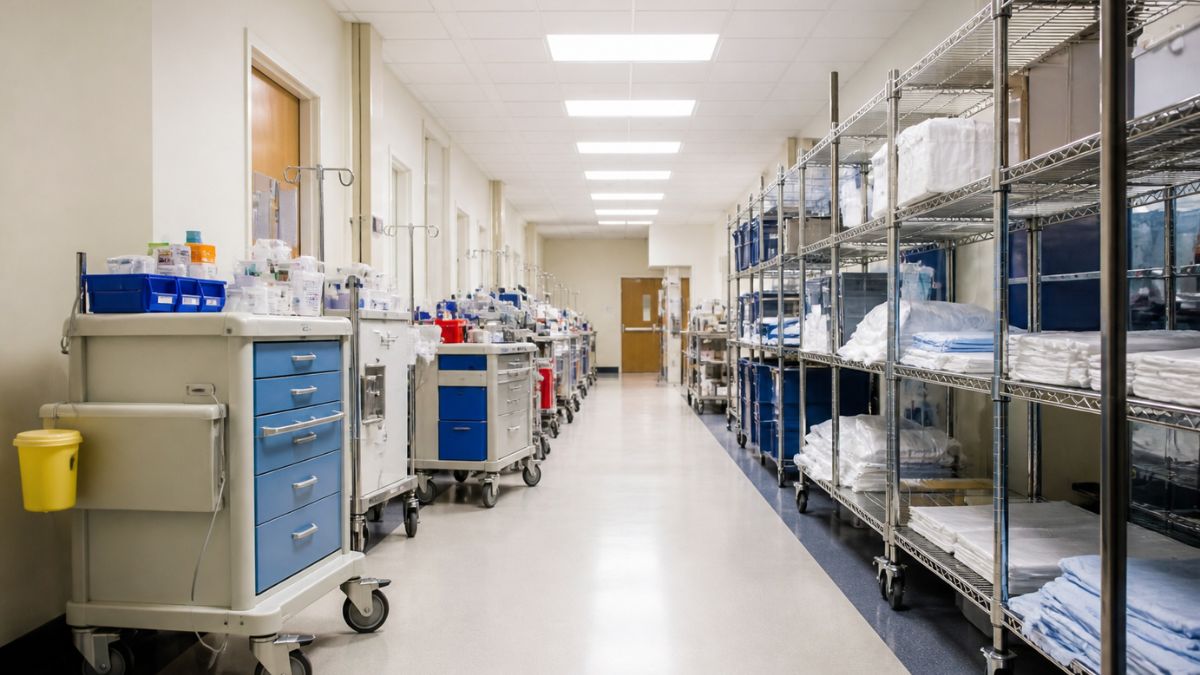
Hospital storage decisions shape patient safety, staff workflow, and capital budgets for a decade or more. Two names come up often on vendor shortlists for sterile processing, operating room, and materials management storage: DSI Direct and Pegasus Medical. Both build serious products. Both carry real hospital references. But they run different playbooks, and the fit depends on what your facility actually needs.
This review compares the two across specialization, service model, product depth, manufacturing, and buying experience. It leans on public company information, customer references, and published positioning. Star ratings are not quoted because neither company sits on consumer review platforms at volume, which is typical for B2B capital equipment.
You will get the most out of this comparison if you are a:
Distribution Systems International, known as DSI Direct, is a California-based healthcare storage company founded by Peter Lane on July 1, 1990. The company is headquartered at 25901 Commercentre Dr., Lake Forest, California. DSI designs, stocks, and assembles its products in Southern California, and it sells directly to hospitals rather than through a distributor network.
The core focus is narrow on purpose. DSI concentrates on Sterile Processing Departments (SPD), Operating Rooms, and the Supply Chain and Materials Management function that feeds both. Flagship product lines include Modu-Max and Modu-Max CTS for sterile instrument storage, Modu-Cell for enclosed OR supply storage, and Modu-Case for case cart systems. The catalog also covers high-density supply storage, wire shelving, crash carts, surgery case carts, mobile track systems, OR cabinets, and workstations.
What separates DSI from a typical product vendor is the service layer around the equipment. The company runs on-site Storage Analyses and Workflow Assessments, produces CAD drawings, calculates ROI, manages installation and inventory transfer, and handles after-sales service. The methodology layer adds 2-Bin Kanban and No-Tear Storage Systems for lean SPD operations.
Ideal customer profile: US hospitals and surgery centers that want a single accountable vendor for storage strategy, design, supply, and installation, with a strong bias toward SPD and OR workflow optimization. Facilities that value domestic manufacturing and shorter lead times will find DSI closely aligned to their procurement criteria.
Pegasus Medical Concepts is a global manufacturer of medical storage systems, modular cabinetry, and medical and procedure carts. US operations are based at 4120 S Frontage Rd., Lakeland, Florida. The company has additional leadership and distribution arms across Europe (Iberia, Italy), Latin America, the Middle East and Africa, and Asia-Pacific. It operates through a worldwide distributor and dealer network and holds US federal contractor status (CAGE code 4RLU8).
The product breadth is wide. Pegasus organizes its portfolio into storage solutions, IV solutions, SPD and CSSD solutions, RFID Kanban, medication management, phlebotomy, emergency solutions, infection control, daily task carts, robotics, and a WheelShare wheelchair rental station. Flagship platforms include the Apollo modular cart line, Salus modular storage for CSSD and SPD, Hygieia storage, Hermes transportation carts, Ecoline procedure and medication carts, and Poly polymer carts. Proprietary methodologies include No-Touch, Color Coding, EZ-Slide Transfer Modules, EZ-Swipe, and the ISO 6040 method.
Public references include hospital projects in Tampa, Orlando, and Miami, and multiple Department of Veterans Affairs medical centers (Tampa, Bay Pines, Loma Linda, San Diego), along with international installations such as Legnano Hospital in Lombardy, Italy, and a CSSD project in Jyväskylä, Finland.
Ideal customer profile: health systems and public sector buyers that need a broad multi-category product range, international deployment capability, or an established US federal contracting relationship. Facilities that prefer to work through distributor channels and want a wide catalog across storage, carts, and specialty solutions will find Pegasus well-suited.
The table below summarizes the key differences at a glance. Specifics are drawn from each company's public materials.
Category |
DSIDirect |
Pegasus Medical |
| Founded | 1990, by Peter Lane | Approximately 20 years in advanced medical storage |
| Headquarters | Lake Forest, California, USA | Lakeland, Florida, USA, with global offices |
| Geographic reach | United States | Four continents, a global distributor network |
| Go-to-market model | Direct sales, turnkey | Manufacturer plus authorized distributors |
| Core specialization | SPD, OR, supply chain storage | Storage, carts, IV, medication, phlebotomy, robotics |
| Flagship product lines | Modu-Max, Modu-Max CTS, Modu-Cell, Modu-Case | Apollo, Salus, Hygieia, Hermes, Ecoline |
| Methodology support | 2-Bin Kanban, No-Tear, lean SPD | No-Touch, Color Coding, ISO 6040, RFID Kanban |
| Services included | Storage analysis, CAD, ROI, install, after-sales | Configurator tools, distributor-led implementation |
| Manufacturing | Southern California, USA | Global |
| Pricing model | Quote-only, direct | Quote-only, via distributor or direct |
| Federal contracting | Not prominent in public materials | US VA contractor, CAGE 4RLU8 |
| Public testimonials | Named the US hospital references on site | Named hospital and VA project references |
| Notable recognition | Cited as a partner in UF Health Shands 2025 SPD of the Year | 2024 partnership with Right Way Medical |
A few reads on this table are worth calling out.
DSI runs deeper in a narrower lane. Pegasus runs wider across more care settings. The first difference shows up in how the sales process feels: DSI quotes and delivers as one company, while a Pegasus purchase often involves a regional distributor handling specification, delivery, and installation. Both models work. The right one depends on how your supply chain team prefers to buy.
Manufacturing location also matters for lead times, tariff exposure, and change orders. DSI builds in California. Pegasus manufactures globally, which supports its international reach, but can introduce more variables in timing for US buyers.
Several areas come through clearly in DSI's favor for US hospitals focused on SPD and OR storage.
DSI has spent 35 years working almost exclusively on sterile processing and operating room storage. The Modu-Max CTS system was built around the specific problem of holes and tears in blue wrap and sterile trays, which is a daily SPD pain point. C. Wayne Root, RN, CSR Manager at St. Joseph Mercy Hospital in Ann Arbor, describes a 15-year partnership where the high-density storage system reduced those wrap failures. Specialization at that depth is hard to match if SPD performance is your primary goal.
A DSI engagement typically moves through storage consultation, workflow assessment, CAD design, ROI calculation, installation, inventory transfer, and after-sales service under one roof. For facility teams already stretched thin on capital projects, having one accountable partner from assessment through go-live reduces coordination load and shortens decision cycles.
Products are engineered, stocked, and assembled in Southern California. That shortens lead times for US buyers, simplifies change orders, and removes some of the supply chain variables that come with global sourcing. Keck Hospital of USC is cited as a project where DSI executed a custom six-room surgery center layout with one-day delivery and installation.
DSI offers on-site storage and workflow analyses and free product trials at no cost to the hospital. For SPD or OR leaders who want to validate a solution before committing capital, this lowers the risk of the buying decision. Few capital equipment vendors in this category offer hands-on trials at that level of access.
The 2-Bin Kanban and No-Tear Storage Systems are product-level expressions of lean SPD thinking. Hospitals running, or moving toward, lean supply chain principles can deploy DSI equipment as part of that operating model rather than bolting process changes onto generic shelving.
Frisbie Memorial Hospital, Northwestern Lake Forest Hospital, St. Joseph Mercy Hospital, Keck Hospital of USC, and Chester Hospital all appear as public DSI customers with named staff testimonials. That density of attributed US references is useful for risk-averse buyers who want to call a peer before signing.
Pegasus has clear strengths in scenarios where breadth and geography matter more than pure SPD depth.
Pegasus operates across four continents through a distributor network. Health systems with international facilities, or GPOs evaluating partners for multi-country rollouts, get a meaningful advantage from that footprint. Public references include Legnano Hospital in Lombardy, Italy, and a CSSD installation in Jyväskylä, Finland.
The catalog extends beyond storage into IV solutions, medication management, phlebotomy carts, emergency carts, infection control accessories, dialysis carts, and a wheelchair rental station. Facilities that prefer to consolidate purchases across multiple care settings with one manufacturer will find more overlap with Pegasus than with a pure storage specialist.
Pegasus holds US federal contractor status with CAGE code 4RLU8 and has delivered projects at multiple VA medical centers, including Tampa, Bay Pines, Loma Linda, and San Diego. For public sector buyers working through federal procurement pathways, that track record reduces onboarding friction.
The Apollo cart line is positioned for multi-department adaptability. For hospitals that prefer a single cart platform, they can configure across OR, ED, procedural areas, and med/surg rather than buying department-specific carts. Apollo offers a consistent interface for staff.
No-Touch, Color Coding, and ISO 6040 are formal methodologies that Pegasus documents and implements. Central Sterile Services Departments that want a named methodology framework to align with international standards have an off-the-shelf reference model to work from.
The honest answer is that both brands can deliver a credible outcome. The decision comes down to your facility profile, buying preferences, and what you want out of the partnership.
Choose DSI Direct if:
Choose Pegasus Medical if:
For most US hospitals and surgery centers focused on sterile processing and operating room storage, DSI Direct is the stronger fit. The depth of SPD specialization, the turnkey service wrap, the domestic manufacturing base, and the willingness to run free assessments and trials reduce both project risk and total coordination effort. If your sourcing question is specifically "who will help us get SPD and OR storage right," DSI has built its entire company around that answer.
Pegasus makes more sense where breadth, federal contracting, or international reach are non-negotiable requirements. Those are real needs for some buyers. They just narrow the field of facilities where Pegasus is the most aligned choice.
Yes. DSI Direct is the common name for Distribution Systems International, a healthcare storage company headquartered in Lake Forest, California. It was founded in 1990 by Peter Lane.
DSI Direct designs, stocks, and assembles its products in Southern California. Domestic manufacturing is a core part of its positioning and supports shorter lead times for US hospital buyers.
Pegasus Medical operates through a combination of direct engagement and a global distributor and dealer network. US federal buyers may purchase through its federal contracting vehicles, while many commercial buyers work through regional distributors.
Both brands use a quote-based pricing model. Neither publishes public list prices. DSI quotes directly from the manufacturer. Pegasus quotes through its direct sales team or an authorized distributor, depending on region and buyer type.
DSI Direct has built its product line and service model around SPD and OR storage, with flagship systems like Modu-Max CTS targeting SPD-specific problems such as blue wrap integrity. Pegasus offers SPD solutions through its Salus system and ISO 6040 methodology, but also spans many other categories. For SPD-led projects, DSI typically offers deeper specialization.
Pegasus Medical holds US federal contractor status (CAGE 4RLU8) and has delivered at multiple VA medical centers. For buyers working through federal procurement pathways, Pegasus has more visible precedent in public records.
DSI Direct publicly offers free on-site storage and workflow assessments and free product trials. Pegasus Medical's trial options vary by product line and regional distributor, so availability should be confirmed during the quote process.
Hospital storage is a long-cycle investment. The equipment you install this year will shape SPD efficiency, OR turnover, and supply chain performance for a decade or more. Choosing the right partner matters more than choosing the right product, because the partner is who you call when something needs to change.
For US hospitals and surgery centers whose primary question is how to get SPD and OR storage right, DSI Direct's combination of specialization, domestic manufacturing, turnkey service, and low-risk trial process is the more aligned choice. Pegasus Medical remains a strong option for buyers with global, federal, or broader multi-category requirements.
The lowest-risk way to pressure-test this for your own facility is a no-obligation Storage Analysis or Workflow Assessment. Book a free on-site assessment with DSI Direct, walk through your SPD or OR with their team, and compare the recommendation against any other vendor quote you hold.
You can request an assessment directly through DSI Direct's contact page, or call (800) 393-6090 to speak with their team.