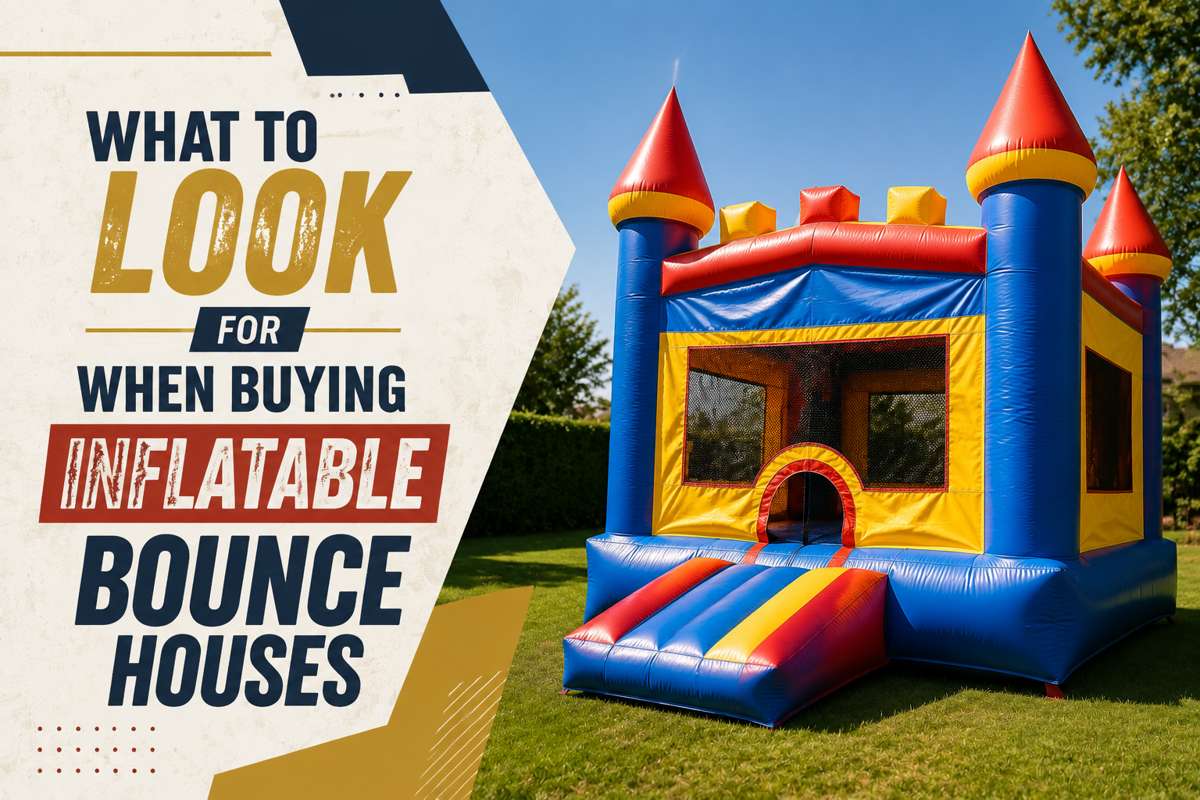
This guide walks through each factor the way an experienced buyer would, with the trade-offs spelled out plainly. An inflatable bounce house is not a lightly regulated toy. The U.S. Consumer Product Safety Commission (CPSC) estimated more than 18,000 bounce house injuries treated in hospital emergency rooms in 2018 alone, so construction quality and safety features are not extras. They are the whole point of buying carefully.
Key takeaways
The single biggest quality difference in an inflatable bounce house is the material and how the seams are joined. Commercial units use thick PVC vinyl with heat-welded, reinforced seams. Budget units use lighter woven fabric held together with simple stitching. Almost everything else, from lifespan to safety, follows from that core construction choice.
PVC vinyl is the industry standard for durable inflatables. Commercial-grade vinyl usually runs 15 to 20 ounces per square yard, roughly 0.55 to 0.7 mm thick, and it is fully waterproof, UV-stabilized, and heavy. Oxford fabric and nylon are the lighter alternatives used in residential units. Their strength is measured in denier, shown as a number followed by the letter D, where the D stands for the thickness of the yarn. Common ratings run from 210D on light backyard units up to 1000D or 1680D on heavier builds, so a 210D bounce house will not hold up like a 600D one.
Seams are where inflatables fail first, so inspect them closely. On premium units, high-stress zones such as the bouncing floor and slide beds are double, triple, or even quadruple stitched, and wet-use areas are heat-sealed so water cannot wick through the needle holes. On cheap units, a single row of stitching at a stress point is a tear waiting to happen. Reinforced stress points and heat-welded seams are among the strongest signals that a unit was built to last.
| Attribute | Commercial PVC vinyl | Residential Oxford/nylon |
| Typical spec | 15 to 20 oz per sq yd (0.55 to 0.7 mm) | 210D to 1680D woven fabric |
| Seams | Heat-welded and reinforced | Stitched, often a single row |
| Water resistance | Fully waterproof | Water-resistant at best, absorbs over time |
| Lifespan (heavy use) | 3 to 5 years or more | About 2 to 3 years |
| Weight and handling | Heavy, needs two people | Light, easy to move, and store |
| Best for | Rentals, frequent or mixed-age use | Occasional backyard family use |
Commercial-grade and residential bounce houses differ in material, construction, capacity, and price. Commercial units are built from heavy PVC vinyl to survive hundreds of setups and mixed-age crowds. Residential units are lighter, cheaper, and made for occasional backyard use by a few small children. The right pick depends on how often and how hard the unit will be used.
Most inflatables fall into three tiers. Retail units are the cheapest, sold through big-box and online stores, and built from light nylon or polyester that may not survive a full season of steady use. Consumer vinyl units, sometimes called crossover units, use PVC vinyl close to commercial grade with reinforced stress points, which suits families who want real durability. Commercial units sit at the top: heavy PVC, heat-welded seams, and compliance with recognized safety standards, built to run for years.
| Tier | Typical material | Best for | Rough lifespan |
| Retail/consumer | Nylon or polyester, light | Occasional backyard use | Under 2 years |
| Consumer vinyl (crossover) | PVC vinyl, reinforced | Frequent family use | 2 to 4 years |
| Commercial | Heavy PVC, heat-welded | Rentals and heavy use | 3 to 5 years or more |
Choose a residential or crossover unit if you are a family buying for your own backyard, expect a handful of uses each year, and value lightweight and easy storage over maximum durability. Choose a commercial-grade bounce house when you plan to rent it out, host frequent events, need it to handle older kids and adults, or want a unit that survives many seasons and holds its resale value.
The right size inflatable bounce house is the one that fits your setup area with room to spare and matches the ages and number of kids using it. Measure your space first, then subtract clearance for anchoring, the blower, and airflow. A unit that barely fits on paper rarely fits in practice.
Age and occupancy limits exist for a reason. A 2022 analysis in the Journal of Pediatric Surgery estimated 159,569 bounce house injuries among U.S. children from 2000 to 2019, found that most occurred at home, and noted that the most severe injuries fell disproportionately on children older than six. The CPSC advises that only children of similar age and size jump at one time and that the posted occupancy limit always be observed. A standard 15 by 15 foot commercial unit can weigh 250 to 350 pounds, so plan for two people to move and set it up.
A bounce house should carry the right certification for its use, ASTM F2374 for commercial units or ASTM F2729 for home-use devices, along with NFPA 701 flame-resistant material. Beyond the paperwork, look for mesh sight windows, reinforced anchor points, a defined emergency exit, and a blower correctly matched to the unit.
Wind is the deadliest hazard, and it is often underestimated. ASTM added stronger anchoring and staking requirements to its standards in 2018, and the current commercial standard is ASTM F2374-24. A 2022 study in the Bulletin of the American Meteorological Society reported that the ASTM guideline sets a maximum wind gust of about 25 miles per hour, yet more than one in five documented wind-related incidents happened at lower speeds. John Knox, the University of Georgia geography professor who led that study, cautioned that a bounce house can be lifted by winds nowhere near severe, which is why every anchor point matters. The CPSC guidance is blunt: if it is windy, do not use a bounce house, and never set one up near power lines, trees, or fences.
A commercial-grade PVC bounce house usually lasts 3 to 5 years, and often longer, under heavy use, while a residential Oxford or nylon unit tends to last about 2 to 3 years. Lifespan depends far more on material, seam quality, and maintenance than on graphics or brand names.
Maintenance is what separates a unit that lasts five seasons from one that fails in one. Clean the vinyl with mild soap and water, avoid harsh or chlorine-based cleaners, and dry the unit completely before rolling it up, since storing it damp invites mildew. Patch small tears early with the included repair kit before they spread. Store the unit rolled, dry, and out of direct weather. Never set an inflatable on concrete or asphalt without a tarp, which protects the floor and keeps many warranties valid. PVC also stiffens below about 40 degrees Fahrenheit, so folding or inflating it in the cold risks cracking along the seams.
Compare bounce house warranties on four points: length, what is covered, what is excluded, and who pays return shipping. A warranty that specifically names seams and material defects as covered tells you more about real build quality than any marketing line.
The Federal Trade Commission requires a written warranty to be available before purchase, so read it first and assume anything not stated is excluded. In practice, commercial dry-use units carry roughly one to three years of coverage, blowers usually carry one year, and high-wear parts such as zippers, Velcro, netting, and printed graphics are commonly excluded. Return shipping on a large inflatable can cost more than the repair itself, so confirm in writing who pays for shipping and labor before you buy.
It helps to see how a manufacturer spells this out. As one example of clear terms, JumpOrange publishes a tiered warranty: three years on dry-use commercial units, 18 months on wet and wet-dry units, and one year on blowers, with stakes and a tarp required to keep the coverage valid. Whether or not you buy from any single brand, that is the level of detail worth demanding before you pay.
| Component | Typical coverage to expect |
| Body vinyl and seams | 1 to 3 years on commercial dry-use units |
| Wet and wet-dry use | Shorter term, often around 18 months |
| Blower | About 1 year |
| Zippers, Velcro, netting | Commonly excluded |
| Printed graphics | Often excluded, may chip or peel |
The better value depends on how you will use the unit, not on price alone. A budget bounce house wins for a family that wants a few backyard afternoons a year. A premium commercial unit wins for heavy, frequent, or mixed-age use, where durability and resale value offset the higher upfront cost.
A premium, commercial-grade bounce house makes sense when the unit will be rented, used most weekends, or exposed to older and heavier riders. A budget or crossover unit makes sense for light, occasional home use where storage space and easy handling matter more than years of service.
Compare the cost per use rather than the sticker price. A unit that costs more but lasts three times as long and survives resale often costs less per event. Factor in the material, seam construction, certification, warranty, and the weight you are willing to move.
Expect a well-built commercial unit to hold air pressure, shape, and color across many seasons with routine cleaning and dry storage. Expect a budget unit to serve occasional use well, but to show wear, fading, and seam stress sooner, with fewer repair options if the fabric tears.
Choose a budget unit if your use is occasional, your riders are young and few, and portability is your priority. Choose a premium unit when the unit earns money, runs often, or must safely handle a mixed-age crowd.
When figuring out what to look for when buying inflatable bounce houses, it’s important to look beyond the aesthetics. Safety experts and seasoned buyers agree on the same short list: verify the certification in writing, anchor every point, respect wind limits, and read the warranty before paying. The regret heard most often comes from buying based on graphics and price, then replacing a torn unit within a year.
The data backs up that caution. The CPSC reported 12 deaths tied to inflatable amusements from 2003 to 2013, and a 2012 study in the journal Pediatrics documented a fifteenfold rise in bounce house injuries among children between 1995 and 2010. Rental operators who buy well tend to standardize on heavy PVC, keep a repair kit and spare blower on hand, and log their anchoring for each setup. Families who are happiest with their purchase usually bought a size they could store and move, confirmed the safety standard, and treated the warranty as a spec sheet rather than fine print. None of that requires expert knowledge, only a willingness to check the details before the sale.
For durability and frequent use, commercial-grade PVC vinyl at 15 to 20 ounces per square yard is the top choice, since it is waterproof and heat-welded. For light, occasional backyard use, Oxford fabric or nylon rated around 600D offers a lighter, more affordable option that lasts a couple of seasons.
Measure the flat footprint of the unit, then add several feet of clearance on every side for stakes, the blower, and a walkway, plus the full inflated height overhead. Also, check that the gates and paths from your vehicle are wide enough for a bulky rolled unit.
They can be safe when set up and used correctly. Confirm the ASTM certification, anchor every point, keep jumpers close in age and size, supervise at all times, and never use the unit in wind or near power lines. The CPSC advises stopping use entirely when it is windy.
A commercial-grade PVC unit typically lasts 3 to 5 years or more with proper cleaning and dry storage, while a residential Oxford or nylon unit usually lasts about 2 to 3 years. Maintenance and seam quality affect lifespan more than price.
Look for ASTM F2374 compliance on commercial units or ASTM F2729 on home-use devices, plus NFPA 701 flame-resistant fabric and lead-free, phthalate-free vinyl. Ask the seller for the compliance documentation in writing.
Yes, with the right steps. Place a tarp under the unit to protect the floor, and use ballast such as sandbags or water barrels instead of stakes to anchor it, since stakes will not hold on hard surfaces. Skipping the tarp can void many warranties.
Buying well is mostly about inspection, not luck. Confirm the material and seams, match the size to your space and your riders, verify the certification, and read the warranty before you pay. Do those four things, and you will avoid the most common regrets, and the fun will outlast the purchase. The market offers strong options at every tier, so the informed buyer has the advantage.
Read more buyer guides like this to make your next purchase with confidence.