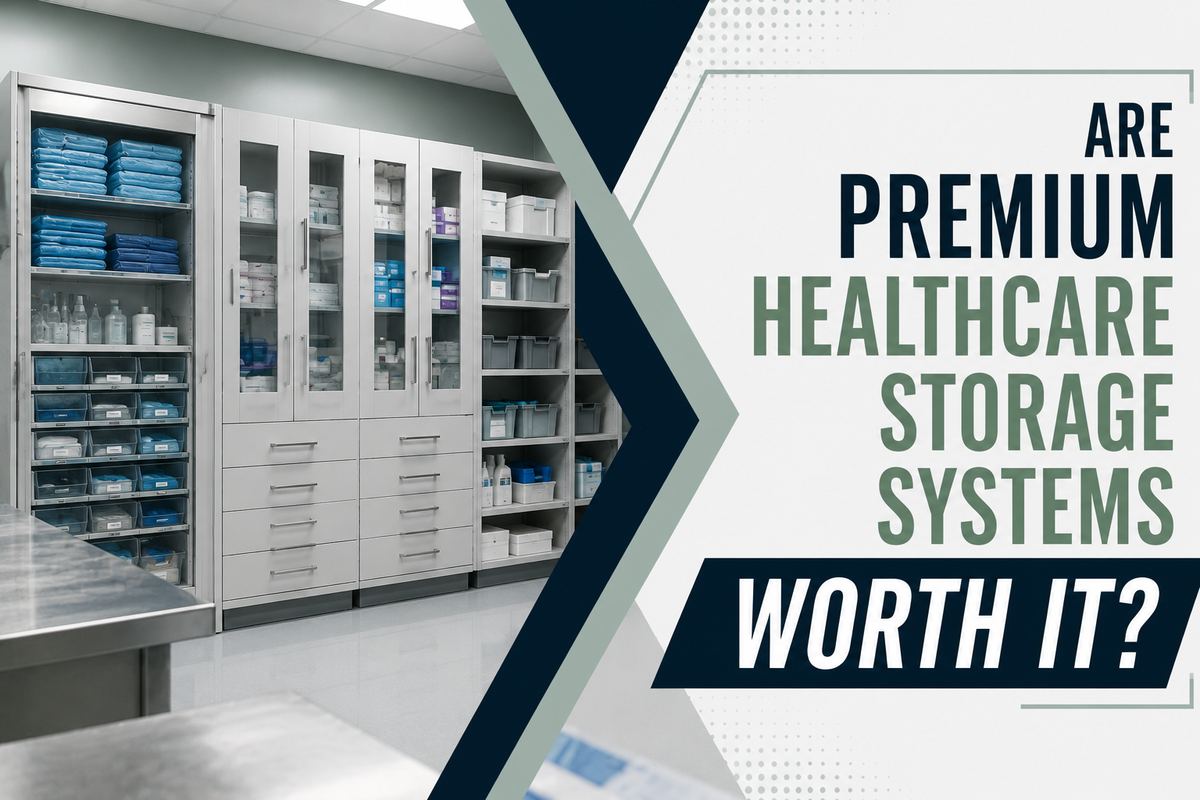
Are premium healthcare storage systems worth it? Sometimes, and the honest answer depends far more on what a department does every day than on the feature list in a brochure. Premium healthcare storage covers a wide span of technology, from powered high-density mobile shelving to RFID smart cabinets and vertical lift modules. Each one solves a narrow problem well and does almost nothing for the others.
The money involved is not small. The American Hospital Association reports that supplies account for 13 percent of total hospital expenses, roughly $181 billion a year, which puts supplies second only to labor. This guide covers which storage technology features change outcomes, which vendor claims deserve a second look, what compliance requires at every price tier, and how to judge whether an upgrade will pay back at your facility.
Key takeaways
A premium healthcare storage system is any storage platform that adds engineering, automation, or data capture beyond plain static wire shelving. The category runs from modular casework and closed cabinetry through mechanical-assist and powered high-density mobile shelving, then up to RFID smart cabinets, vertical lift modules, and automated dispensing cabinets.
Static wire shelving is the baseline that nearly every facility already owns. Wire shelving is inexpensive, easy to reconfigure, and carries no software dependency. The limits of static shelving show up in three predictable places: an aisle is needed between every row, nothing records what left the shelf, and open wire surfaces scratch over time and become harder to clean.
High-density mobile shelving mounts shelving units on carriages that roll along floor tracks, so a room needs one moving aisle instead of an aisle for every row. Southwest Solutions documented a hospital supply room that gained 33 percent more capacity by replacing six-level wire racks with nine-level basket drawer units, then recovered roughly 40 percent more floor space by eliminating static aisles.
RFID smart cabinets and vertical lift modules add data capture on top of storage. A smart cabinet reads tagged items as staff remove them and writes consumption back to the materials system without anyone scanning anything. A vertical lift module brings the shelf to the operator instead of sending the operator down the aisle. Both carry recurring costs that static shelving does not: tags, software subscriptions, integration work, service contracts, and training.
No. Premium healthcare storage systems earn their cost in departments where inventory is expensive, expiration-dated, serialized, or squeezed into a footprint that cannot grow. In a med-surg supply room stocked with gloves, gauze, and saline, the same budget usually returns more when it is spent on replenishment discipline than on hardware.
Choose powered high-density mobile shelving if the room is physically out of floor space and the facility cannot add square footage, since capacity gained inside an existing footprint avoids construction entirely.
Choose RFID smart cabinets when the items inside are individually expensive, serialized, or expiration-dated, such as stents, implants, biologics, and tissue, because the value of the tracking data exceeds the cost of tagging.
Choose two-bin Kanban on standard shelving when the inventory is low cost, high volume, and consumed at a predictable rate. BlueBin reports that hospitals running its two-bin system see a 5 to 7 percent reduction in annual medical supply expense and a 15 to 25 percent decrease in overall inventory, which is a vendor figure and worth validating against your own baseline.
Wait on any premium upgrade when nobody can state the current PAR levels, the current stockout rate, or the current expired-product write-off in dollars. Storage technology reports on a process; storage technology does not invent one.
Five features separate storage technology that changes clinical and financial outcomes from storage technology that only changes the invoice. Each one maps to a measurable result: less time hunting, fewer expired items, more usable capacity, or cleaner audit evidence.
Storage technology options separate cleanly by what they are good at, what they cost to run, and what they demand from staff. The table below compares the main tiers on the factors that decide whether an upgrade holds up after year one. Installed pricing varies too widely by room, region, and configuration to publish as a single reliable range.
| Storage tier | Best suited for | Ongoing commitment | Realistic gain |
| Static wire shelving | Low cost, high turnover consumables | Cleaning and reconfiguration only | Baseline capacity, no consumption data |
| Two-bin Kanban on standard shelving | Commodity supplies at point of use | Bin discipline and a staffed replenishment route | Lower supply expense where bin discipline is maintained |
| Modular casework and closed cabinetry | Sterile storage, clinic exam rooms, SPD | Cleaning protocol and periodic hardware service | Supports closed-storage and clearance requirements |
| High-density mobile shelving | Rooms that cannot expand | Floor track cleaning and carriage maintenance | Roughly 33 to 40 percent more usable capacity in documented cases |
| RFID smart cabinets | High value, serialized, expiration-dated stock | Tags, software subscription, integration, training | Item-level traceability and expiration visibility |
| Vertical lift modules and carousels | Central stores with high pick volume | Service contract, power, uptime planning | Faster picking in high-volume central stores; independent payback data is limited |
Every storage vendor quotes a capacity gain, a time saving, and a payback period. All three are usually true under the conditions the vendor measured, and those conditions are rarely stated on the slide. The fix is not skepticism about the technology; the fix is asking what the number was measured against.
| Common claim | What to ask before you accept it |
| Doubles your storage capacity | Doubled against which baseline layout, at what shelf depth, and with how many shelf levels? A capacity gain that assumes nine levels is not available in a room with a low ceiling. |
| Recovers 80 to 90 percent of floor space | At which facility, with how many SKUs, and was the comparison against static shelving with a full aisle between every row? |
| Eliminates manual counting | What happens when a tag fails, an item is returned unscanned, or a vendor ships untagged stock? Who reconciles the variance, and how often? |
| Pays for itself in 12 months | Does the payback model include tags, the software subscription, integration hours, the service contract, and staff training time, or only the hardware? |
| Improves compliance | Which standard and which clause, and what evidence does the system hand a surveyor during an unannounced survey? |
A published cath lab example shows why the net number matters more than the gross one. Cardiovascular Business reported that University Health Care System in Augusta saw $101,000 in total savings during a three-month RFID trial, which translated to an annual return of $55,000 once the $46,000 annual software fee was deducted. The technology worked. The headline number and the budget number were still two different figures.
Four beliefs show up repeatedly in storage purchases that disappoint, and each one leads a facility to buy the right product for the wrong problem. Naming them early tends to change what gets specified.
Myth: new hardware will fix a broken replenishment process. Storage hardware makes an existing process faster and more visible. A room with no owned PAR levels and no replenishment route will produce the same stockouts after the upgrade, only in a more expensive cabinet.
Myth: more storage capacity prevents stockouts. Excess capacity often produces the opposite problem. Cardinal Health has estimated that 7 to 10 percent of products expire on hospital shelves, as reported in Diagnostic and Interventional Cardiology. Deeper shelves make expired stock easier to hide, not easier to catch.
Myth: premium equals compliant. Clearance rules under AAMI ST79 and NFPA 13 apply to a basic wire rack and a fully automated system in the same way. Any unit whose top shelf sits inside 18 inches of a sprinkler deflector creates a finding regardless of price.
Myth: automation reduces headcount. In most published healthcare cases, the labor benefit shows up as reallocated hours rather than eliminated positions. One RFID smart cabinet study at University Hospital Cruces found supervisory time on the logistics chain fell 58 percent, from 995 minutes to 428 minutes, which returned clinical hours rather than cutting staff.
An upgrade decision comes down to three questions asked in order: does the problem match the technology, can the alternatives be compared on the same basis, and is there a baseline to measure against afterward. Working through them in that sequence prevents most storage buyer regret.
An upgrade makes sense when a room is at capacity and construction is not an option, when expired-product write-offs are measurable and recurring, when staff routinely leave a sterile area to hunt for supplies, or when a renovation is already opening the walls, and casework can be specified at the same time. It also makes sense when a facility must produce case-level or patient-level traceability for implants and tissue, since manual logs rarely survive an audit intact.
Compare options on total cost of ownership across five years rather than on the purchase order. Include tags, subscription fees, integration hours, service contracts, and training. Ask every vendor for two named references at a similar bed count and service mix, and ask those references what broke in the first year. Then confirm that the proposed configuration physically fits the room, including ceiling height, sprinkler layout, floor loading, and door swings.
Expect capacity and traceability gains to arrive faster than financial gains. Cost savings typically follow only after PAR levels are reset using the new consumption data. Facilities that skip the PAR reset often keep the same inventory value in a smaller space, which is a real space win and no financial one. Independent payback benchmarks by system type remain thin, so treat any single figure carefully:
Sterile storage clearances are fixed requirements that apply at every price point. Writing in Infection Control Today, sterile processing consultant and educator Nancy Chobin, RN, AAS, ACSP, CSPM, CRER, summarizes the long-standing storage guidance: keep items at least 18 inches from a sprinkler head under fire code, 8 to 10 inches off the floor to allow cleaning and prevent splashing, and 2 inches from an outside wall where applicable.
The 18-inch rule is not a storage standard at all. It comes from NFPA 13, which requires clearance between the sprinkler deflector and the top of storage, which is why the top shelf height on any unit needs to be checked against the sprinkler layout of the specific room before ordering. Manufacturers that specialize in healthcare storage systems for clinical environments publish shelf heights and unit dimensions for exactly this reason.
Chobin also notes that overcrowded shelving damages packaging and instruments, and recommends that sterile processing teams meet with infection prevention and materials management to review whether a different shelving type, including high-density shelving, would increase storage capability. That is a useful sequence to copy: review the inventory and remove what is no longer used, then decide what storage the remaining inventory actually needs.
Environmental conditions matter as much as clearances. Packaging integrity depends on stable temperature and humidity, and monitoring records are part of what a surveyor reviews.
What buyers describe after a year tends to sound the same across facility sizes. The capacity gain is obvious immediately, and nobody argues with it. The traceability gain shows up at the first recall, when a search that used to take a shift takes a few minutes. The financial gain, when it appears, appears in the second year after PAR levels have been reset using real consumption data.
The staffing angle is often underweighted in the business case. A time-motion study of acute care nursing published in Proceedings of Singapore Healthcare found nurses spent 4 to 10 percent of their time preparing and clearing requisites, a category that includes searching for consumables, and referenced UK survey work in which more than a third of nurses reported spending at least an hour per shift looking for items.
Retention is part of the same picture. Owens & Minor reported that 43 percent of hospital supply chain leaders surveyed said they had lost nurses because of supply challenges or shortages. When a storage business case only counts inventory carrying cost, it misses the operational cost that clinical staff feels every shift.
Cost pressure makes the timing question sharper in 2026. Vizient projects healthcare supply chain prices to rise 2.78 percent between July 2026 and June 2027, with technology and facility spending overtaking pharmacy in anticipated cost growth for the first time in more than a decade.
Usually only in targeted areas. A small surgery center rarely has the pick volume to justify a vertical lift module, but it often has a sterile storage room that is over capacity and an implant inventory that needs traceability. Closed casework plus high-density shelving in the sterile core, with basic tracking on implants, tends to cover the actual risk.
Documented healthcare installations report meaningful gains inside the same footprint. Actual results depend on ceiling height, sprinkler layout, and how many access aisles the workflow requires.
The published evidence points that way for high-value stock. Adventist Health White Memorial reported a 95 percent improvement in tracking expired products after automating an inventory of about 1,700 SKUs, according to Supply Chain Dive. RFID reduces expiry by making expiration dates visible and searchable, not by changing how much stock a facility chooses to hold.
Better storage helps, but only when it is configured correctly. Clearance requirements under AAMI ST79 and NFPA 13 apply regardless of what a unit costs, and an expensive system installed too close to a sprinkler deflector still produces a finding. Closed storage, documented environmental monitoring, and enforced stock rotation carry more weight than price tier.
It varies widely by system type, and published figures usually reflect a single site. The honest approach is to build the model from your own numbers: annual expired-product write-offs, inventory carrying cost, square footage recovered, and staff hours currently spent counting and searching. Then subtract subscriptions, tags, integration, and service before calling it payback.
In most cases, yes. Right-sizing PAR levels and establishing a replenishment route costs little and reveals how much storage the facility actually needs. Facilities that reset the process first frequently discover they need less capacity than planned, which changes the specification and lowers the purchase.
Premium healthcare storage is worth it when the problem it solves is the problem you actually have. Rooms at capacity, expensive expiration-dated stock, traceability obligations, and clinical staff losing hours to supply hunts all justify the spend. A tidier supply closet does not. With supply expenses climbing faster than reimbursement and operating margins thin, the discipline of matching the technology to a measured problem matters more than it did when margins were wider.
The most useful next step is not a quote. It is a baseline: current PAR levels, current stockout rate, annual expired-product write-offs in dollars, and square footage of storage in use. With those four numbers, any vendor comparison becomes straightforward, and any payback claim becomes testable.
Read more articles like this to keep sharpening how you evaluate healthcare storage and supply chain investments.