
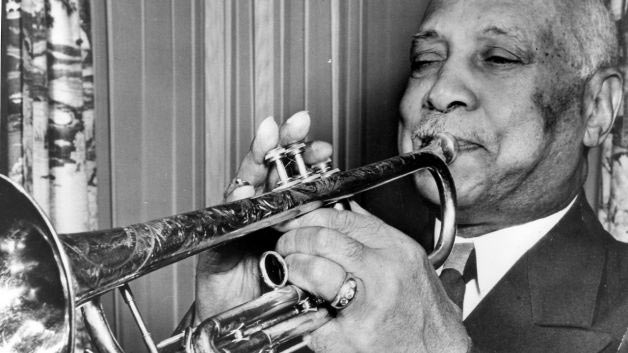
W.C. Handy played with a number of ensembles and toured across the Midwest and the South, where he learned about the African American folk music that would eventually become known as the blues. Handy's subsequent compositions, including "St. Louis Blues," "Memphis Blues," and "Aunt Hagar's Blues," helped popularise the genre and became commercially successful.
William Christopher Handy, composer, pianist, and music publisher, was born on November 16, 1873, in Florence, Alabama to Elizabeth Brewer Handy and Charles Barnard Handy. The son and grandson of Methodist pastors, young Handy showed an early passion for music, which was encouraged by his maternal grandmother. However, his father had different ideas and was adamantly opposed to his son pursuing secular music, only consenting to pay for organ tuition. Despite this, Handy remained devoted to his passion and began playing the cornet while also taking Acappella singing classes at school.
At the age of 15, Handy reportedly joined a minstrel show, a theatrical play of the period that included African American music in caricature form. The group split after many performances. Later, Handy attended the Teachers Agricultural and Mechanical College in Huntsville, Alabama, graduating in 1892. Afterward, he became a schoolteacher, although he continued his singing career in his spare time.
Handy's contributions to the development of the blues were impacted by his exposure to African American musical folk traditions throughout his travels and performances. He created the Lauzette Quartet in 1892 with the aim of performing at the Chicago World's Exhibition later that year, but when the fair was postponed until 1893, the group was forced to disband. Handy arrived in St. Louis, where he endured days of destitution, starvation, and homelessness.
Handy persisted, continuing to play the cornet in performances, and finally found his way to Henderson, Kentucky, where he was engaged as a musician by the wealthy. At a concert there in 1898, Handy met his future wife, Elizabeth Virginia Price; they wed in July of that year. Together, they would have two children and remain married until her passing in 1937.
But Handy's first major musical break came in 1896 when he was selected to lead W. A. Mahara's Minstrels. He remained with the ensemble for many years, performing around the country and even in Cuba. 1900 saw Handy and Elizabeth settling in Huntsville, Alabama, where Handy taught music, but by 1902 he was back on the road.
After a stint in Clarksdale, Mississippi, where he commanded the Black Knights of Pyhtias and immersed himself in the local version of the blues, Handy relocated in Memphis, Tennessee, where he often performed in the Beale Street clubs before the end of the first decade of the 20th century. In 1909, Handy penned "Mr. Crump," a future campaign song titled after Memphis mayoral candidate Edward H. "Boss" Crump. (Crump won the election despite the fact that the song's lyrics were not particularly favorable.) Later, the song was transformed into "Memphis Blues." Handy signed a deal to publish the song in 1912, and he subsequently became a pioneer in introducing the form's song structures to big audiences.
"Memphis Blues" is commonly regarded as the first blues song ever released. It was a financial success. Handy, however, never reaped the financial benefits of the song's fame since he sold the rights to it and fell victim to unethical business methods. Having learned his lesson the hard way, he resolved to establish a framework to preserve ownership of his music and co-founded a publishing company with Harry Pace.
In 1914, under the Pace & Handy Music Company, Handy recorded his next hit, "St. Louis Blues," which described the struggles he had endured in the city's namesake (which later became known as the Handy Brothers Music Company, after Pace left the venture). The song "St. Louis Blues" became a major success and was recorded several times during the next few years. Other Handy successes from 1914 include "Yellow Dog Blues" and "Beale Street Blues" (1916). Eventually, he would be recognized for the composition of dozens of songs.
Later Life and Succession
Handy relocated his company to New York in 1918 to avoid racial animosity in the South, and subsequently achieved fame with his song "Aunt Hagar's Blues." During the 1920s, he continued to popularise blues to broad audiences by producing the book Blues: Anthology (1926), which comprised blues arrangements for vocals and piano, and by arranging the first blues concert at Carnegie Hall in New York City in 1928.
Handy published Negro Authors and Composers of the United States in 1935 and W.C. Handy's Collection of Negro Spirituals in 1938, continuing to work continuously throughout the 1930s. A few years later, in 1941, he wrote Father of the Blues, his autobiography. Due to a brain fracture sustained from a fall from a railway platform, Handy was blind by the middle of the 1940s, despite having had vision issues for years.
In 1954, Handy wed his lifelong helper, Irma Louise Logan, and he lived to see his compositions played by jazz greats. The blues composer died of pneumonia on March 28, 1958, at the age of 84, in New York City. More than 20,000 mourners attended his burial in a Harlem church, and many more lined the streets to pay their condolences. Nat King Cole portrayed the famed composer in the biopic St. Louis Blues, which premiered in theatres throughout the country only a few short months after his passing.
Handy's songs continue to be performed in blues, jazz, pop, and classical music styles. Handy is commonly referred to as the "Father of the Blues," and his vision carries on via the annual W.C. Handy Music Festival in Alabama.
To learn more about celebrities, click here.


