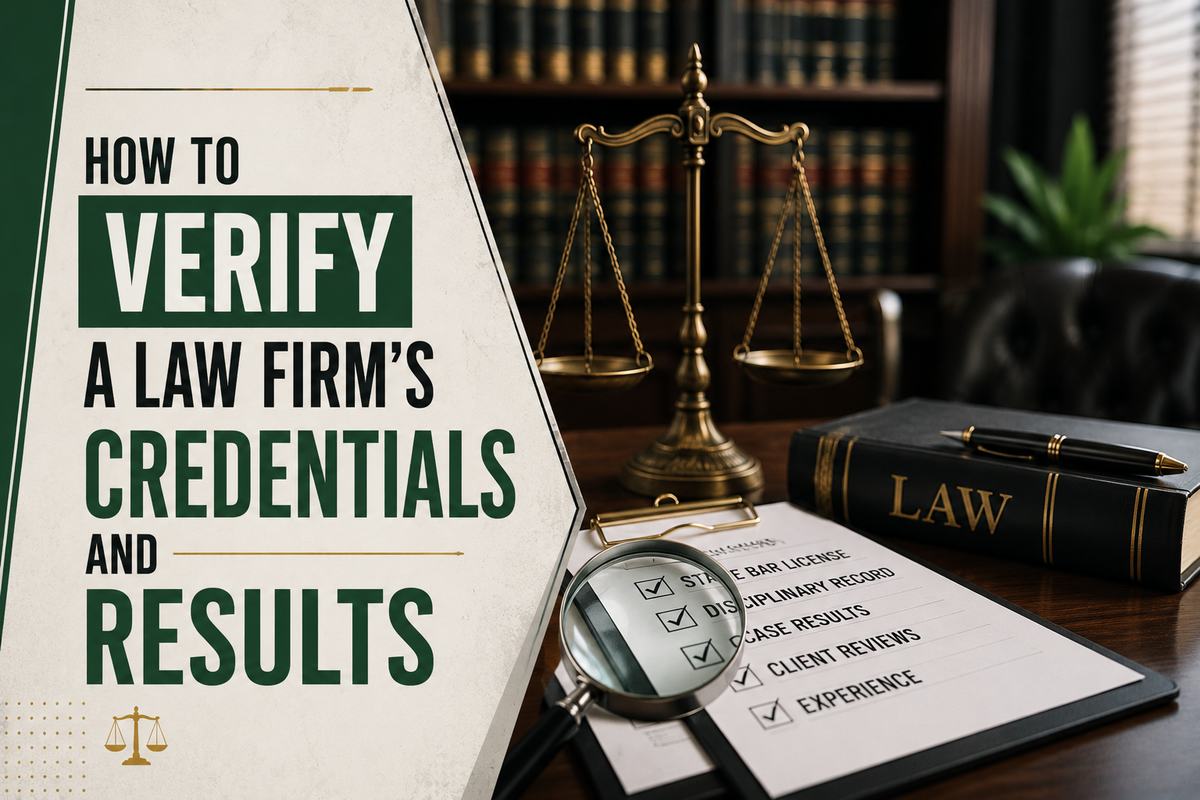
Most people hire an injury lawyer during the worst month of their life, which is exactly when careful shopping is hardest. The good news is that how to verify a law firm's credentials and results is mostly a records exercise, not a judgment call. In California, license status, public discipline, board certification, court filings, and the required terms of a contingency fee contract are all public or all legally owed to you in writing. Thirty minutes of checking separates a firm that can document its work from one that only advertises it.
This guide walks through what each credential actually proves, how to trace an advertised settlement back to a real case, which awards carry weight and which are marketing, and the questions that get honest answers in a free consultation. It also covers what a fair fee agreement looks like under California law, and what a realistic timeline is once a case is filed.
Key takeaways
Verifying a law firm means confirming three separate things: that the lawyers hold an active license in your state, that their documented experience matches your type of case, and that the outcomes they advertise can be traced to identifiable cases. Credentials are checkable in minutes. Results usually require one direct question that a legitimate firm answers without discomfort.
The reason the burden falls on the buyer is structural. California’s Rules of Professional Conduct prohibit false or misleading communications about a lawyer’s services under Rule 7.1, but nobody pre-screens law firm websites the way a regulator reviews a drug label. Enforcement is complaint-driven and after the fact. A claim can sit on a homepage for years before anyone questions it.
That gap is why the phrase "over $50 million recovered" tells you almost nothing on its own, while "we filed 14 cases in Orange County Superior Court last year and tried two to verdict" tells you a great deal. The first is a marketing figure with no external reference point. The second can be checked against a public court index in about five minutes.
Search the lawyer by name or bar number in the State Bar of California Attorney Search. The public profile shows license status, bar number, admission date, law school, county, and any public discipline. Status must read "Active." Inactive, suspended, and not eligible to practice all mean the lawyer cannot represent you right now, whatever the reason.
Discipline is not hypothetical. The State Bar publishes disciplinary history on the same profile, and it is worth reading before you sign anything.
Two details are easy to miss. First, check the individual attorney who will handle your file, not just the name on the building, because firms often advertise under a founder while associates carry the caseload. Second, confirm the firm entity itself, since a California professional law corporation is a registered business and a mismatch between the retainer letterhead and the registered name is worth a question.
| What to verify | Where to check it | What a clean result looks like |
| License status and bar number | State Bar of California Attorney Search | Status reads Active, and the admission date matches what the firm told you |
| Public discipline | The same State Bar profile, plus State Bar Court records | Profile shows no public record of discipline |
| Certified specialist claim | State Bar certified specialist search | The certifying organization is named in the ad and appears on the profile |
| Firm entity | California Secretary of State business search | The professional corporation is active and matches the retainer |
| Recent court experience | County superior court case index, or PACER for federal cases | Cases appear under the named attorney within the last three to five years |
| Advertised results | Ask for case name, number, and county, then pull the docket | The firm supplies them without hesitation |
Under California Rule of Professional Conduct 7.4, a lawyer may not claim to be a certified specialist unless currently certified by the State Bar’s Board of Legal Specialization or by an accredited organization, and the certifying organization must be named in the communication. A firm that says "specialist" with no organization attached is either sloppy or overreaching.
Here is the practical wrinkle for injury clients. The State Bar of California directly certifies specialists in eleven fields, including appellate, bankruptcy, criminal, family, immigration, legal malpractice, taxation, and workers’ compensation. Personal injury is not on that list. The closest accredited credential is Civil Trial Advocacy certification from the National Board of Trial Advocacy, which the State Bar accredits. So the absence of a specialist designation at a personal injury firm is normal, and its presence at one is a genuine differentiator.
Where certification does exist, the bar is meaningful. The State Bar requires certified specialists to pass a written exam, practice at least five years with a minimum of 25 percent of their work in the specialty, complete extra continuing education, and earn favorable evaluations from peers and judges familiar with their work. Certified specialists are also the only attorneys searchable by practice area in the State Bar’s own tool.
Choose a board-certified trial lawyer if liability is contested, the defendant is a commercial carrier or a hospital, or the case is likely to be tried rather than settled. Choose a firm without certification when liability is clear, treatment is finished, and the work is claim negotiation, provided the firm can still show recently filed cases in your county.
Split advertised outcomes into two buckets. Verdicts are public, filed with a court, and traceable by case number and county. Settlements usually are not, because the overwhelming majority resolve confidentially and never produce a public judgment. Any honest evaluation of a firm’s results starts by accepting that only one of those two buckets can be independently confirmed.
So ask for specifics rather than totals. A fair request sounds like this: name two cases in the last three years with facts close to mine, tell me the county and case number, and tell me whether the case was yours from intake or referred in from another firm. Referred cases matter because a firm can accumulate impressive results while doing the second half of the work on someone else’s file.
Then calibrate the trial question. In the U.S. Department of Justice Bureau of Justice Statistics survey Tort Bench and Jury Trials in State Courts, 2005, roughly 3 percent of motor vehicle tort cases were resolved by bench or jury trial. A firm with two verdicts in five years is not unusual. A firm with zero verdicts, zero recent filings, and a wall of settlement banners is a different picture, because insurers price claims partly on which firms actually file and try cases.
Some firms make this easier by publishing representative settlements broken out by claim type instead of one aggregate figure. Kerr Law Firm, a personal injury practice in Fountain Valley, California, publishes settlement results grouped by case type, including diminished value and loss of use claims, which lets a reader see the kind of work the firm actually does rather than a single headline number. That format is worth looking for anywhere you shop, because it is far easier to compare against your own facts.
| Advertised result | What it is worth | The catch |
| Total dollars recovered since a founding year | Signals longevity and case volume | Aggregate figures cannot be traced to individual cases |
| Individual settlement amounts | The closest thing to a comparable for your claim | Most settlements are confidential and never filed with a court |
| Jury verdicts | Fully public and checkable by case number | Verdicts are rare in tort cases, so a short list is normal |
| No fee unless we win | Describes the standard contingency structure | Says nothing about who pays case costs if you lose |
| Referrals from other lawyers | Peers vouching with their own clients | Usually self-reported and not independently audited |
Rating signals are useful when you know who issued them and what they measured. Peer-reviewed lists carry more weight than pay-to-appear directories, and regulator records carry more weight than both. The Super Lawyers selection process is a reasonable benchmark: peer nominations plus independent research, no self-nomination, and a list capped at a small share of the lawyers in a state.
Client reviews measure something different and still matter. Reviews tell you about responsiveness, staff behavior, and whether calls get returned, which is what most complaints to bar associations are actually about. Reviews do not verify outcomes. Read them for service patterns across dozens of entries rather than for the dollar figures individual reviewers mention.
| Signal | Who decides | What it proves | What it does not prove |
| Active bar license | State Bar of California | The lawyer may legally represent you today | Nothing about skill or results |
| Certified legal specialist | State Bar Board of Legal Specialization | Exam, five years practice, peer and judge review | Not available in personal injury |
| Civil trial certification | National Board of Trial Advocacy, accredited by the State Bar | Documented trial experience against a national standard | Not a predictor of your settlement value |
| Super Lawyers listing | Thomson Reuters peer nomination and research | Peer recognition capped at 5 percent of a state’s lawyers | Not case specific and not a court endorsement |
| Peer review rating | Surveyed attorneys and judges | How peers rate ethics and legal ability | Nothing about fees or communication |
| Client reviews | Individual clients | Service experience and responsiveness | Not verified case outcomes |
California does not leave contingency fee terms to custom. Business and Professions Code Section 6147 requires the contract to be in writing, signed by both the attorney and the client, with a duplicate signed copy handed to the client at signing. It must state the agreed contingency rate, how disbursements and costs affect both the fee and your recovery, and what you might owe for related matters outside the contract. Failure to comply makes the agreement voidable at the client’s option.
The most expensive line in any injury retainer is not the percentage; it is the cost of treatment. Two firms quoting the same rate can produce very different checks depending on whether the fee is calculated before or after case costs are deducted, and on whether you owe advance costs if the case loses. Ask both questions in plain words and get the answer in the document, not in conversation.
| What Section 6147 requires in the contract | Why it matters to you |
| The agreed contingency rate, stated in writing | The percentage is negotiated between you and the firm, not fixed by law |
| How disbursements and costs affect the fee and your recovery | Determines whether the fee comes off the gross recovery or the net |
| What you may owe for related matters outside the contract | Prevents surprise charges on property damage claims or lien work |
| A duplicate signed copy provided at signing | You leave with the identical document the firm keeps |
| A statement of Section 6146 limits in medical malpractice claims | Statutory caps apply in those cases, and a lower rate can be negotiated |
A consultation is a working interview, and the answers are more revealing than the credentials. These eight questions take about ten minutes and expose almost everything that matters about how a firm operates.
What buyers tell us afterward is consistent: the firms that gave crisp, specific answers to questions four through seven were also the firms that produced the fewest surprises at settlement. Vague answers about costs early almost always predict friction at disbursement.
Some warning signs are regulatory violations, and some are simply patterns that correlate with bad outcomes. Treat the first group as disqualifying and the second as a reason to keep shopping.
Hiring counsel makes sense when injuries require more than a single clinic visit, when liability is disputed, when a commercial vehicle or a business premises is involved, or when an adjuster is pressing for a recorded statement or a quick release. It makes less sense when property damage is the only real loss and the carrier has already accepted fault, because a fee on a small claim can outweigh the improvement in outcome.
Compare on four axes and ignore everything else: license and discipline record, documented experience with your specific claim type, cost treatment in the fee agreement, and who actually handles the file. Two firms with identical advertising can differ enormously on the last two. Put the answers side by side in writing before deciding, because the differences that matter are rarely visible on a homepage.
Most injury claims resolve without a lawsuit. For claims that are filed, California’s civil case disposition time goals direct trial courts to aim for 75 percent of unlimited civil cases disposed of within 12 months, 85 percent within 18 months, and 100 percent within 24 months. Those are court management goals rather than promises about your case, but they set a realistic frame: a filed injury case commonly runs 12 to 24 months, and any firm predicting a specific dollar figure in the first meeting is guessing.
| Your situation | Firm profile that usually fits | What to confirm first |
| Soft tissue injury, clear liability, treatment finished | A local firm that resolves claims before suit | Who negotiates the claim and how often you get updates |
| Disputed liability or a commercial defendant | A firm with recently filed cases and trial experience | Case numbers for filings in the last three years |
| Catastrophic injury or wrongful death | A firm with trial counsel and capital to advance costs | Whether costs are advanced and what happens if you lose |
| Property damage, diminished value, or loss of use | A firm that handles these claims routinely | Whether the firm takes these claims at all |
| Already signed elsewhere and want to switch | Any firm that will explain lien and fee division rules | How the prior firm’s lien gets resolved |
The most common mistake we see is comparing percentages instead of comparing net outcomes. A client will choose a 33 percent quote over a 35 percent quote without asking whether costs are deducted before or after the fee is calculated, which can affect the final check more than the two-point difference in rate does. The number that matters is what lands in your account, not the number on the retainer.
The second pattern is assuming the lawyer in the advertisement is the lawyer on the file. Buyers who ask "who will call me back" during the first meeting almost always report better experiences later, regardless of firm size. The third is skipping the bar lookup entirely because a firm looks established, which is exactly the assumption the State Bar’s public protection program exists to correct.
One more thing worth knowing about verifying a law firm’s credentials and results: nearly every firm expects these questions from sophisticated clients and referring attorneys. Asking them does not mark you as difficult. Discomfort in response to a plain question about case costs or trial history is itself the answer.
Yes. The State Bar of California’s attorney search is free, public, and requires only a name or bar number. The profile it returns includes license status, admission date, county, law school, and any public discipline. There is no reason to pay a third-party site for information the regulator publishes at no cost.
No. A clean record means the lawyer has not been publicly disciplined, which is a floor rather than a recommendation. Most attorneys never face discipline. Use the record to rule firms out, then use case experience, cost terms, and communication practices to rule one in.
Only if certified by the State Bar’s Board of Legal Specialization or an accredited organization, with that organization named in the communication. Because personal injury is not one of the fields the State Bar certifies directly, the relevant credential is usually Civil Trial Advocacy certification through the National Board of Trial Advocacy.
Usually you cannot confirm it directly, because settlements are typically confidential and never produce a public judgment. What you can do is ask for the county and case number of filed cases with similar facts and check those dockets, and ask whether the case was handled from intake or referred in from another firm.
Clients may generally change counsel, but the first firm may assert a lien for the value of work already performed, which is then resolved between the two firms out of the eventual recovery. Ask any new firm to explain in writing how the prior lien will be handled before you sign a second agreement.
Sometimes. A firm that files suit, retains experts, and tries cases carries costs and risk that a settlement-only practice does not, and on a contested claim that difference can produce a larger net recovery even at a higher rate. Compare expected net outcomes and cost treatment rather than the headline percentage.
Verifying a law firm is not about distrust. It is about matching a specific case to a firm that can document the relevant experience, put its cost terms in writing, and tell you who is answering the phone. Every one of those checks is free, and none of them requires legal training: the bar profile, the court index, the fee agreement, and eight straight questions in the first meeting.
Read more articles like this one to sharpen how you evaluate professional services before you commit, and keep the checklist above handy the next time you or someone in your family needs to hire counsel under pressure.