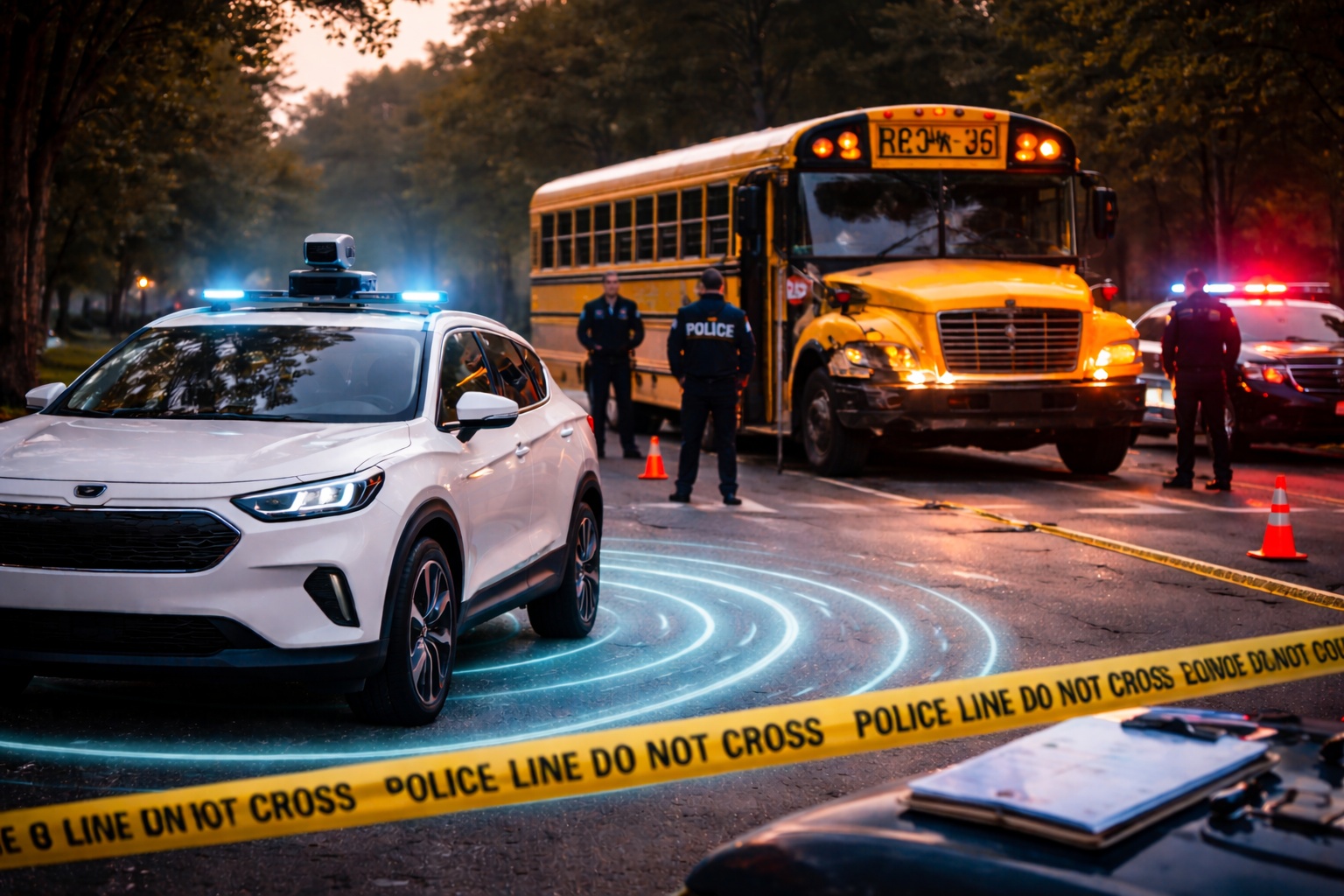
Federal safety regulators have launched investigations into autonomous vehicles after multiple reports of robotaxis failing to stop for school buses with extended stop arms, raising fresh questions about the readiness of self-driving systems on public roads.
The National Transportation Safety Board (NTSB) and the National Highway Traffic Safety Administration (NHTSA) said they are reviewing incidents involving self-driving cars that did not obey school bus stop signals, potentially endangering children boarding or alighting buses.
According to preliminary accounts, some self-driving vehicles operated by major technology companies passed stopped school buses without stopping, despite traffic laws in all 50 states mandating that motorists stop when a school bus displays its stop arm and flashing lights.
Officials have not yet disclosed how many such incidents have occurred, citing ongoing investigative activity, but transportation safety advocates say the situations highlight a critical vulnerability in autonomous driving technology.
“Safe interaction with vulnerable road users, especially children, must be foundational to any autonomous system permitted to navigate public streets,” said an NTSB spokesperson in a statement.
Regulators are evaluating whether the incidents warrant broader enforcement action. NHTSA can request recalls, issue safety recommendations, and pursue civil penalties if vehicle makers are determined to have violated federal vehicle safety standards.
Industry observers note that autonomous systems rely heavily on sensor perception and software classification to detect and respond to dynamic road environments. Interpreting the unique configuration of a stopped school bus with an extended stop arm introduces complexity into those perception systems.
“These systems have to interpret not just a static object but a dynamic context — children approaching the bus, other vehicles responding appropriately, and a wide range of light and weather conditions,” said an automotive safety analyst.
Both NTSB and NHTSA have substantial recent experience with autonomous vehicle issues. Last year and into 2025, regulators investigated other high-profile autonomous system misjudgments, including incorrect yielding and failure to recognize emergency vehicles.
Manufacturers of self-driving vehicles have responded by asserting that safety protocols continue to evolve. Many companies highlight extensive internal testing and redundant sensor systems designed to prevent exactly these types of misinterpretations.
In one statement, a leading autonomous vehicle developer said safety remains its “top priority,” and that additional software updates and simulation testing are underway following reports from field operations.
Despite industry reassurances, federal and state lawmakers have expressed growing impatience. Some legislators are calling for pause orders on robotaxi expansion until clear autonomous safety benchmarks are established.
A group of state transportation officials recently sent a letter urging clearer federal standards for school bus interaction, school zone speed handling, and pedestrian prediction algorithms.
Safety advocates say the incidents illustrate the broader challenge of integrating autonomous vehicles safely into complex real-world traffic systems.
“Even small errors can have severe consequences when children are involved,” said a representative of a traffic safety nonprofit. “We need more transparency from manufacturers and stringent federal oversight.”
As investigations continue, the regulator findings could shape U.S. policy on autonomous vehicle deployment. Pending outcomes may influence future rulemaking and set precedents for how self-driving technology integrates with existing traffic laws.